Ornamental Grasses in Landscaping: The Soft, Swaying Look Your Yard Is Missing
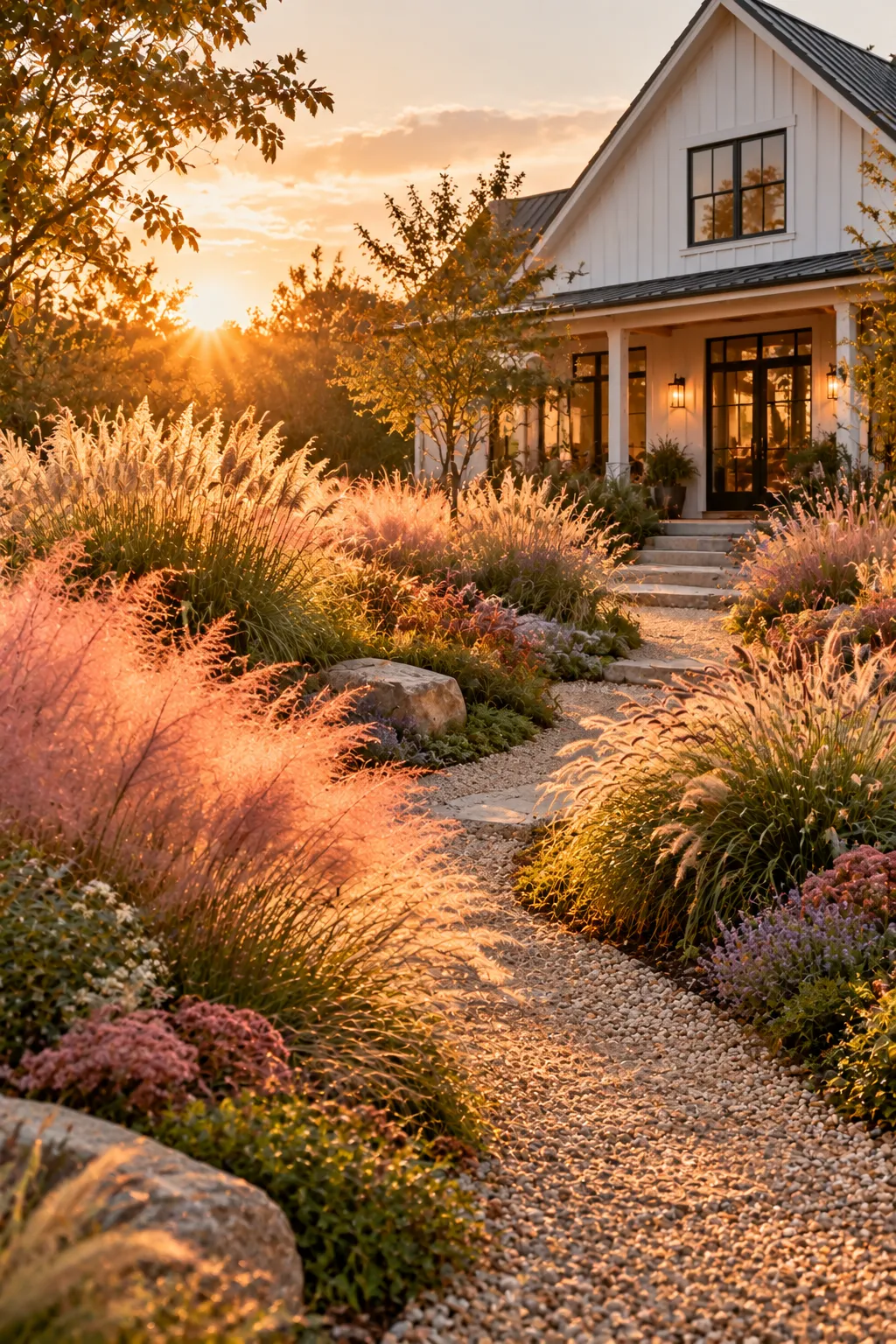

Flowers get all the attention, but grasses are what make a garden feel alive. They sway when the breeze picks up, catch the evening light like spun gold, and stay beautiful long after the petals drop. If your yard looks a little stiff or static, this is usually the missing piece. Below are 15 ways to use ornamental grasses in landscaping, from big dreamy drifts to a single sculptural clump in a concrete pot.
Plant One Grass in a Big, Sweeping Drift
One clump of grass looks nice. Thirty of the same grass flowing in a long curve looks like a designer was here. Repetition is the oldest trick in landscaping, and grasses are made for it.
Pick a single variety like Karl Foerster feather reed grass and plant it in a loose river shape instead of a straight row. Stagger the plants so the drift reads as one soft mass, spacing them about as far apart as their mature width. By midsummer the gaps close, and the whole bed ripples together every time the wind moves through.
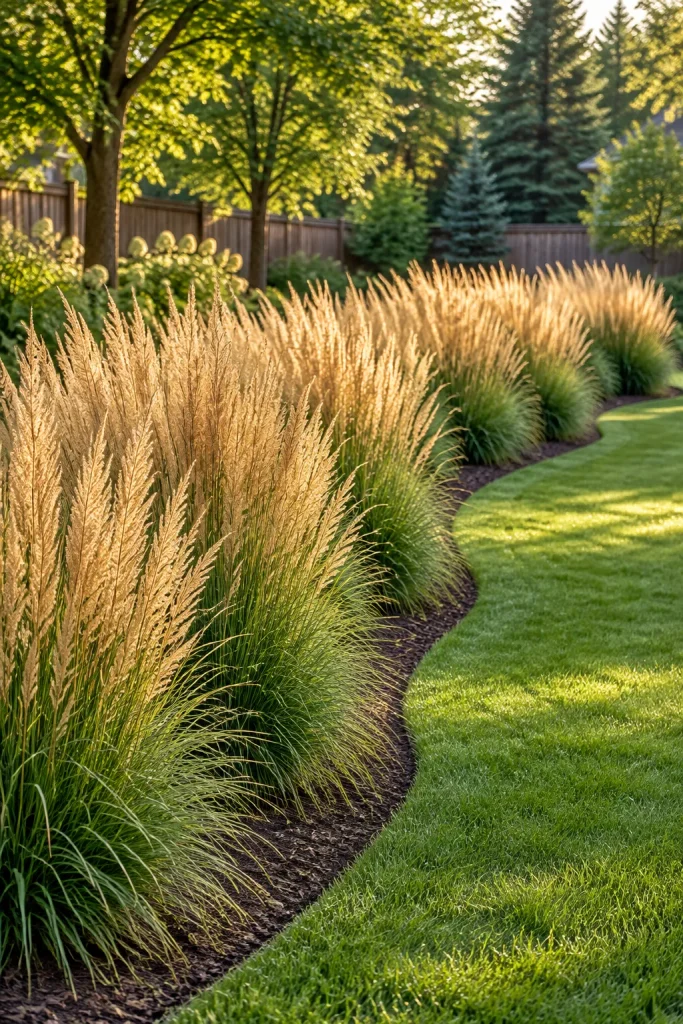
Edge a Winding Path With Fountain Grass
There’s something lovely about brushing past soft plumes on your way to the front door. Fountain grass arches outward in a graceful mound, so it naturally spills over path edges and blurs hard lines. Walk that path in August and the fuzzy, bottlebrush flowers feel almost like petting a cat.
Plant it on both sides of a curving stepping-stone or gravel path, keeping it a foot or so back from the edge so it doesn’t swallow the walkway. ‘Hameln’ stays compact at about two feet tall, which suits narrow paths perfectly. For a richer look, try purple fountain grass, though it’s grown as an annual in colder zones.
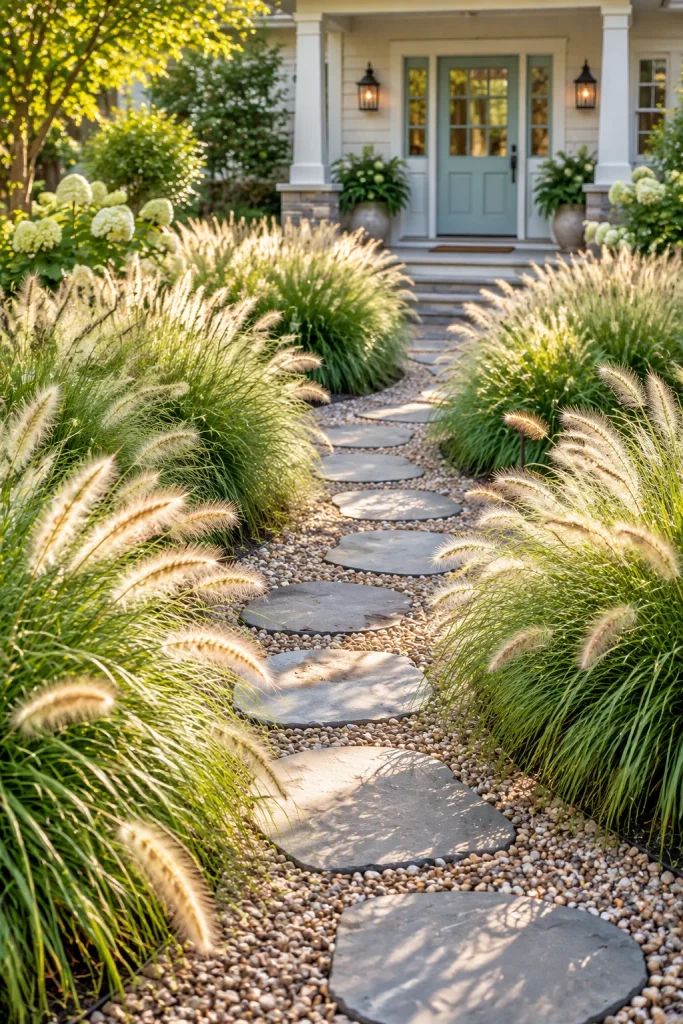
Let Pink Muhly Turn Your Fall Garden Into Cotton Candy
If you’ve ever saved a photo of a pink, misty cloud of grass, it was probably pink muhly. For most of the year it’s a tidy, fine green clump you barely notice. Then in early fall it erupts into airy rosy plumes that look like someone breathed pink smoke across the bed.
It’s most magical in a mass planting where the haze can build, and even better when low sun shines through it. Pair it with silvery plants like lamb’s ear or dusty miller to keep the palette soft. Give it full sun and well-drained soil, and it’ll shrug off heat and drought.
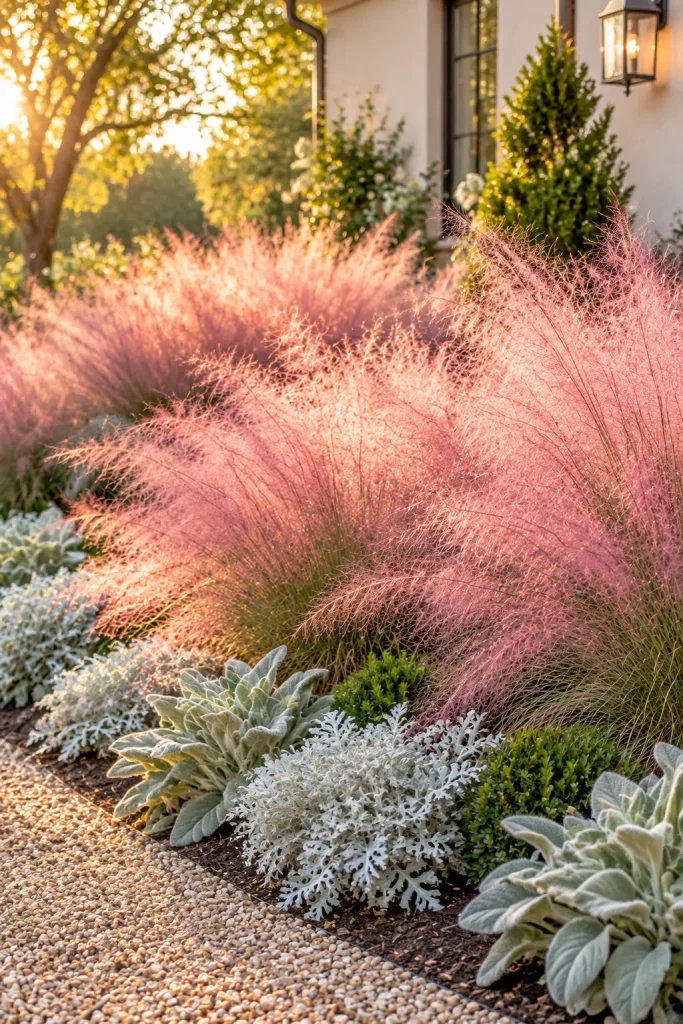
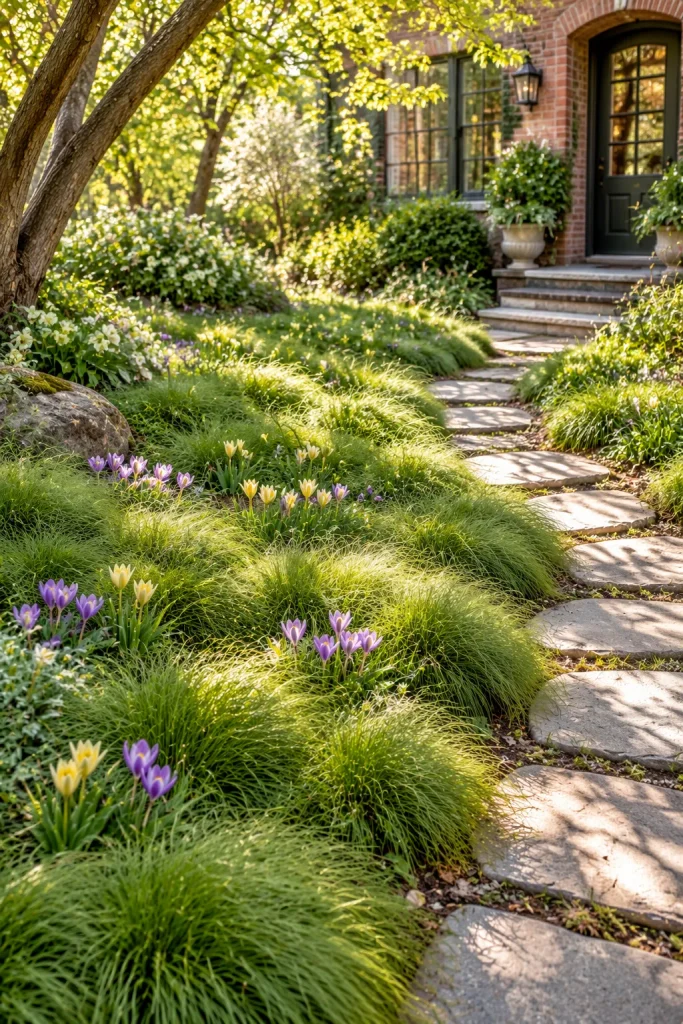
Swap Part of Your Lawn for a Soft Sedge Meadow
Tired of mowing a patchy lawn? A low meadow of sedges gives you that same green-carpet feel, only looser, shaggier, and far more interesting to look at. Sedges like Pennsylvania sedge and Texas sedge stay short, handle light foot traffic, and rarely need cutting.
You don’t have to rip out the whole yard. Start with the awkward strip along a fence or the shady corner where turf never thrived anyway. Tuck in spring bulbs like crocus or species tulips so the meadow wakes up with color every spring.
This is one spot where budget matters. Plug trays of sedges cost far less than individual gallon pots when you’re covering a big area. They take a season to knit together, but the payoff is a lawn alternative that looks lush without weekly mowing.
Build a Gravel Garden With Blue Fescue and Boulders
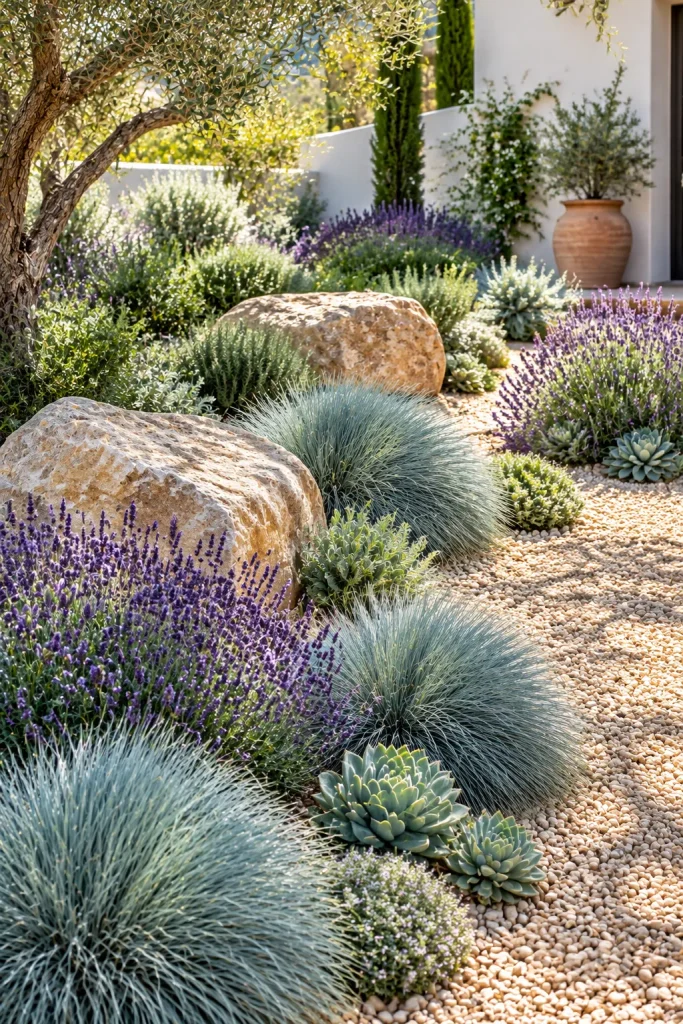
Gravel gardens have that effortless Mediterranean feel, and small blue grasses are their best friend. Blue fescue forms neat, spiky pincushions in an icy silver-blue that looks almost unreal against warm pea gravel. Scatter them in loose groups of three and five, then add a few chunky boulders to anchor the scene.
Mix in low succulents, lavender, or creeping thyme for contrast. The gravel mulch keeps roots cool, cuts down on weeds, and makes everything look intentional. Once established, this is one of the most water-wise looks you can create, and it still feels lush and designed.
Make One Tall Grass the Star of the Show
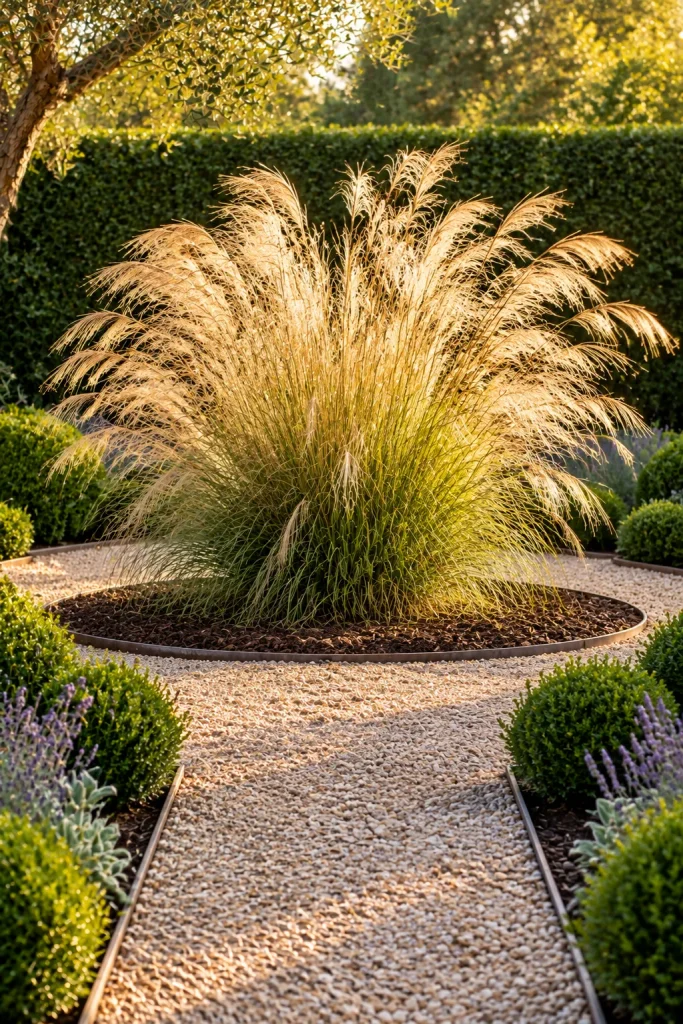
Not every grass has to play nice in a group. A single towering clump of maiden grass or giant feather grass holds its own the way a sculpture would, especially with open space around it. Think of it as living art.
Place it where your eye naturally lands: the end of a path, the center of a round bed, or framed by a window you look out of every day. Leave breathing room so its fountain shape stays readable. Low groundcover or plain dark mulch underneath keeps the focus exactly where you want it. In parts of the eastern US, some Miscanthus types self-seed aggressively, so check what’s invasive locally or choose a sterile cultivar.
Soften a Modern Home With Wispy Feather Grass
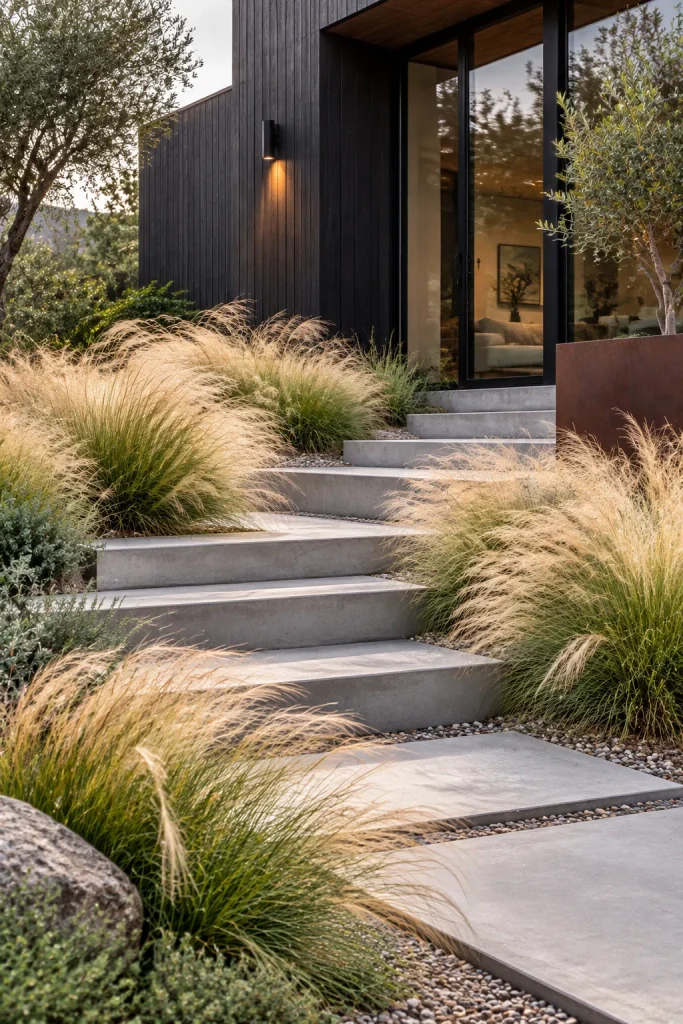
Clean lines, dark siding, big windows, concrete steps. Modern homes look sharp, but they can feel a bit cold without something soft nearby. Fine-textured grasses fix that almost instantly.
Mexican feather grass is the classic pick, with blond, hair-like strands that move in the smallest breeze. Plant it in loose, irregular clusters against black cladding or along a poured concrete walkway, and the contrast between hard and soft becomes the whole point of the design. Skip the neat rows here, because the looser the planting, the better it balances all those right angles. In parts of California and Australia it can spread into wild areas, so prairie dropseed makes a good stand-in there.
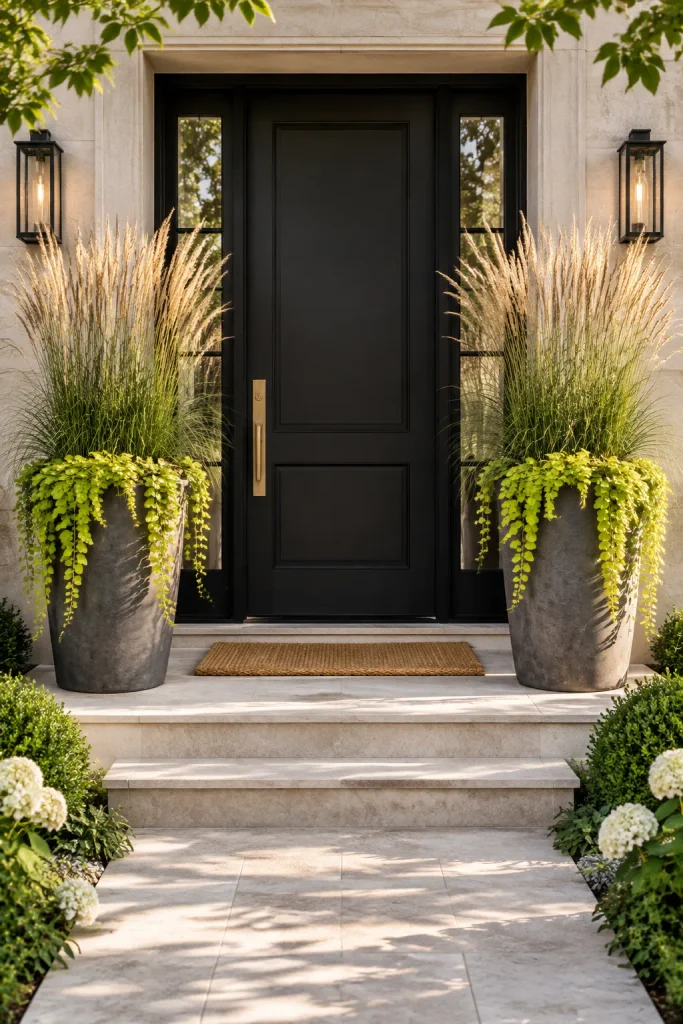
Tall Grasses in Oversized Planters by the Door
No garden bed? No problem. Ornamental grasses look incredible in pots and bring height and movement to spots that are all hardscape, like a front stoop, a rooftop, or a balcony.
Go big with the container. One tall fiberglass or concrete planter with a single grass looks far more expensive than a cluster of small pots. Try a matching pair of feather reed grass flanking the front door, or a chunky terracotta pot with Japanese forest grass spilling over the rim, finished with creeping Jenny trailing around the base.
Drainage holes are non-negotiable, since grasses hate sitting in soggy soil. In cold climates, choose frost-proof pots so they don’t crack in winter. Potted grasses dry out faster than those in the ground, so a deep soak once or twice a week in summer keeps them full.
Pair Grasses With Prairie Flowers for a Wild, Layered Border
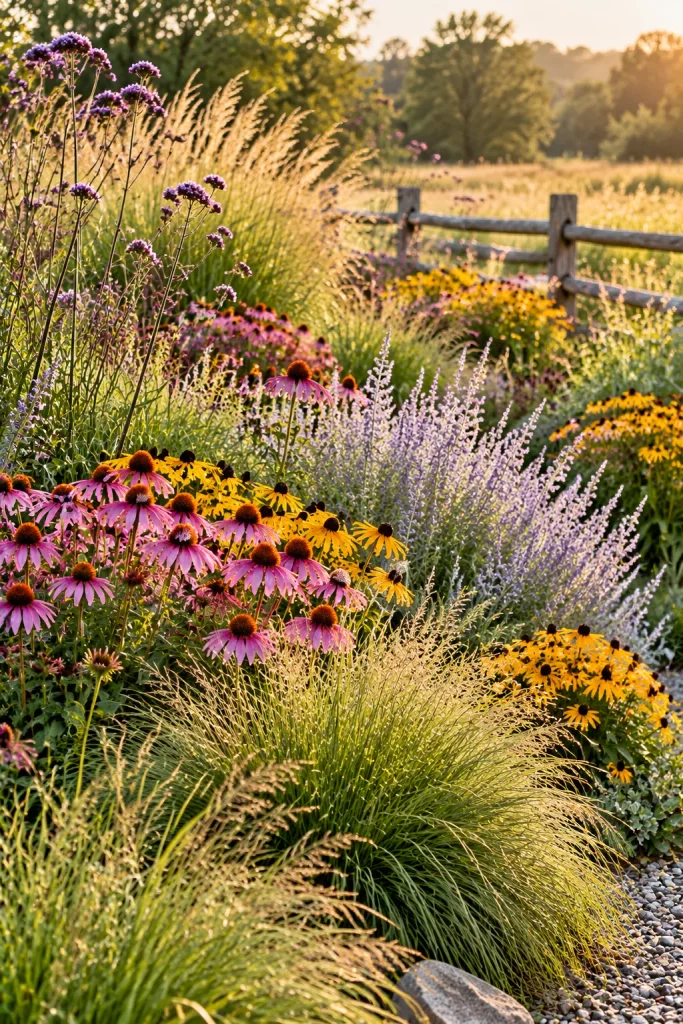
This is the look you see in those dreamy European-style gardens, where grasses and flowers weave together like a painting. The grasses create a soft, flowing backdrop, and bold blooms float on top. It feels wild and romantic but takes surprisingly little fuss.
Start with a fine grass like prairie dropseed or switchgrass as your base layer. Then drop in coneflowers, black-eyed Susans, Russian sage, and tall verbena in loose groups. Leave the seedheads standing into fall and you’ll get visiting goldfinches, plus a bed that fades to tawny gold as the season winds down.
The trick is balance. Aim for roughly half grasses and half flowers so the planting stays airy instead of crowded. Too many flowers and it reads as a cottage border; too many grasses and it can look flat in early summer.
Plant Where the Golden Hour Hits
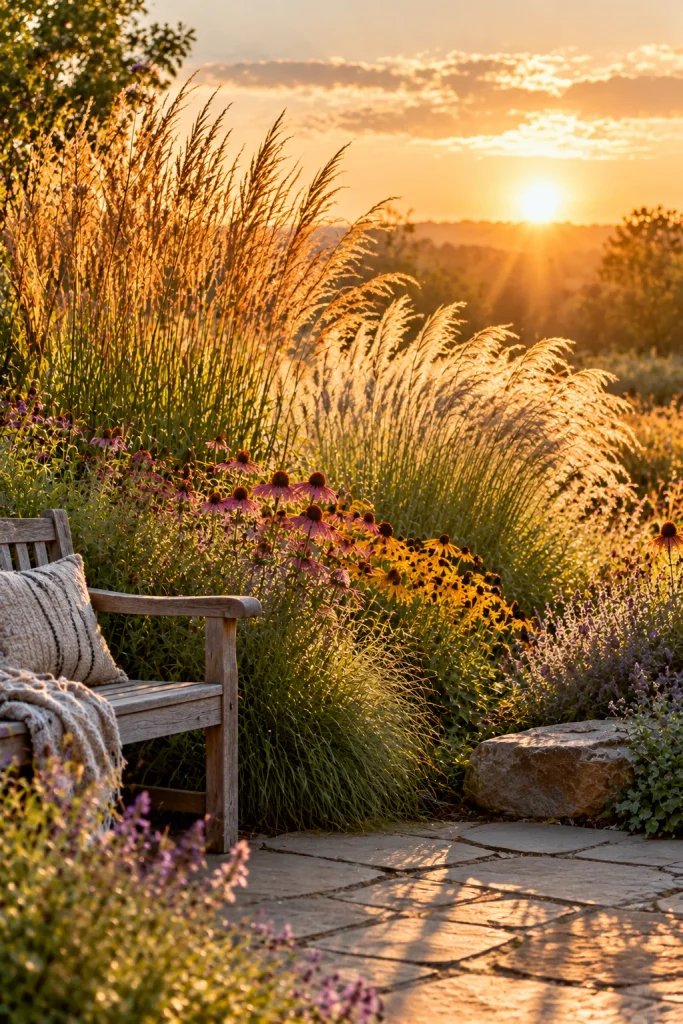
Here’s the secret behind those glowing grass photos you keep saving. The plumes aren’t magic, they’re backlit. Place grasses between you and the setting or rising sun, and every seedhead lights up like a filament.
Work out where the low evening light slants across your yard, usually the west side, and plant airy-flowered grasses there. Miscanthus, switchgrass, and pink muhly all glow beautifully. Sit on your patio at sunset in September and you’ll see why designers obsess over this.
A Living Privacy Screen That Moves
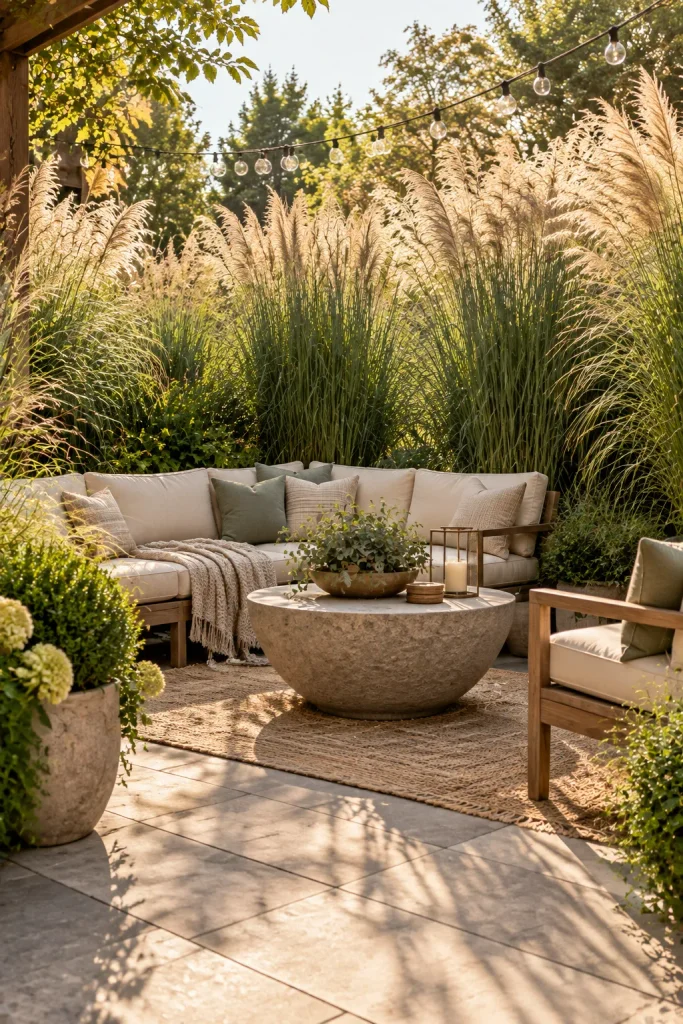
Fences block the view, but they don’t exactly feel dreamy. A row of tall grasses gives you privacy with softness and sound, that gentle rustle that makes a patio feel tucked away. Many varieties reach six to eight feet by late summer.
Switchgrass ‘Northwind’ grows upright and dense, making it ideal for a narrow screen along a property line. For more height, giant Miscanthus can top ten feet, though it needs room. Plant in a slightly staggered double row so the screen looks full from every angle.
Keep in mind that grass screens are seasonal. They’re cut back in late winter, so you’ll have a few open weeks each spring. New growth shoots up fast, and by early summer your hideaway is back.
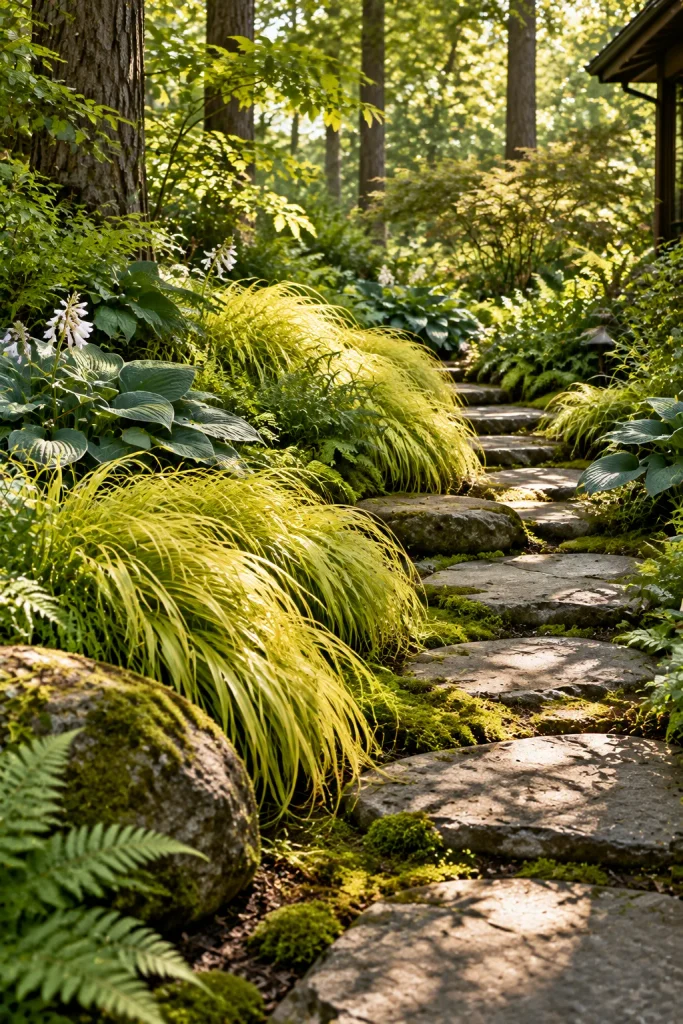
Brighten Shady Corners With Japanese Forest Grass
Most grasses crave sun, but Japanese forest grass is the exception every shade garden needs. Its cascading, bamboo-like blades all flow in one direction, like a combed-over waterfall. The golden variety ‘All Gold’ practically glows in dim spots under trees.
Plant it in drifts along a shady path or between hostas and ferns for a lush woodland feel. It’s slow to fill in, but worth the wait. Keep the soil evenly moist, since it sulks in dry shade.
Let Them Stand Tall Through Winter
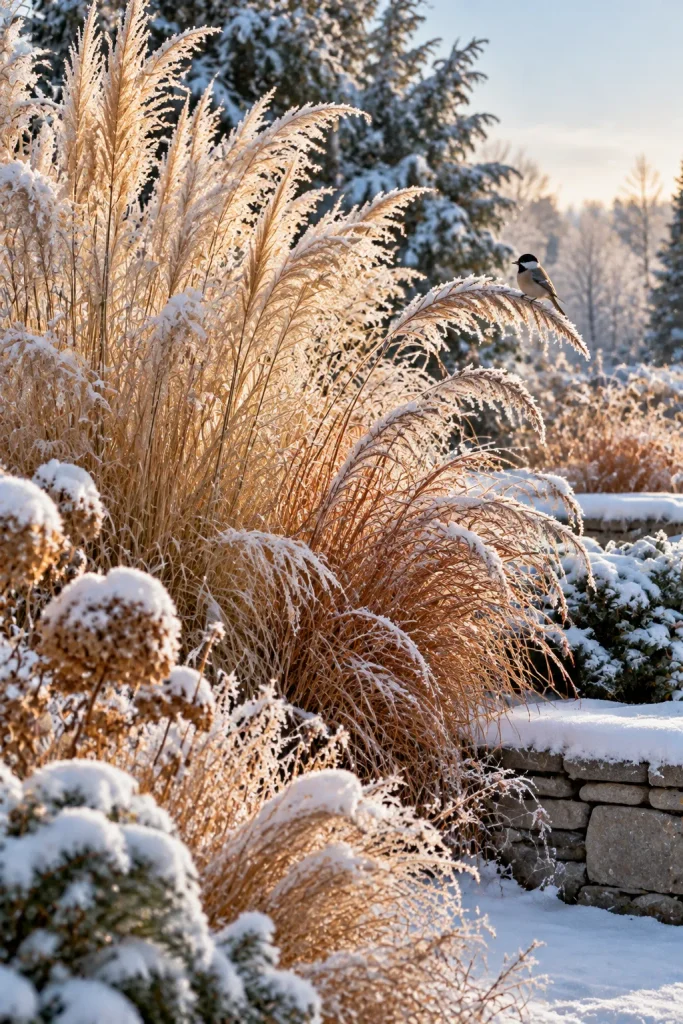
Resist the urge to tidy up in fall. Ornamental grasses are among the few plants that still look beautiful in winter, holding their shape in shades of wheat, copper, and cinnamon. On a frosty morning, every blade is edged in white sparkle.
Snow settles on the plumes like powdered sugar, and the dried stems rattle softly in the wind. They also shelter birds and beneficial insects through the cold months. Wait until late winter or very early spring, just before new green shoots appear, then cut them down to a few inches. Tie each clump with twine first and cleanup takes minutes.
Uplight Your Grasses at Night
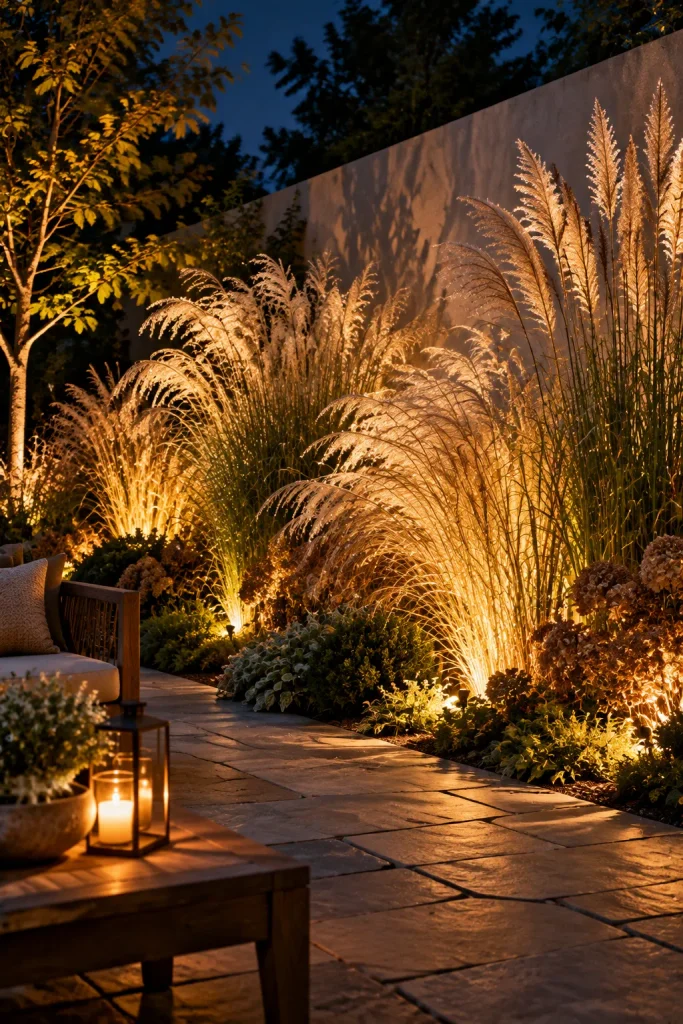
Grasses don’t clock out when the sun goes down. A single low spotlight at the base of a clump throws its blades into silhouette, and every breeze sends shifting shadows across a wall or fence. It’s one of the easiest ways to make your yard feel like a resort after dark.
Use warm white LED spikes, around 2700K, for a cozy glow instead of a harsh blue cast. Aim them upward through taller grasses like Miscanthus or feather reed grass. Solar lights work fine for small beds, while low-voltage systems give you more control over brightness.
Frame a Fire Pit or Patio With Warm-Toned Grasses
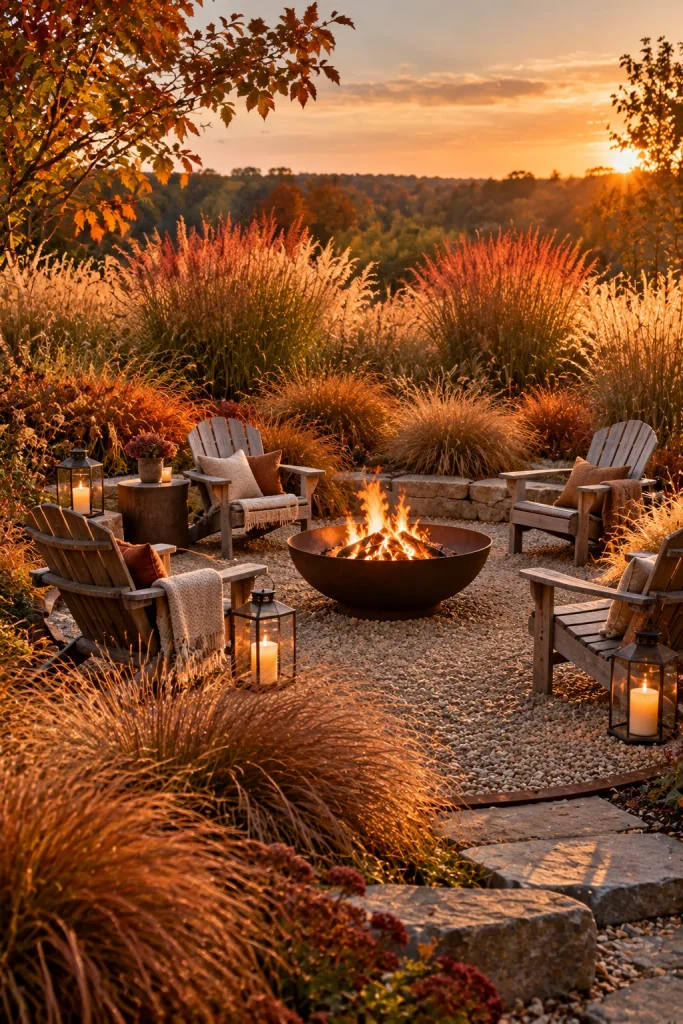
Grasses come in far more than green, and color can completely change the mood of an outdoor room. For a cozy gathering spot, lean into warm tones. Bronze carex, orange New Zealand sedge, and red-tipped switchgrass like ‘Shenandoah’ look like embers when planted around a seating area.
Surround a gravel or flagstone fire pit patio with these warm grasses, keeping taller ones at the back and shorter mounds near the chairs. Leave several feet of clearance from the flames, since dried grass is flammable. Add weathered wood chairs and a few lanterns, and the space glows even before you light a match.
For a cooler, calmer feel elsewhere in the yard, switch to blue oat grass and silver fescue. Repeating one color family in a few different spots, like a pot by the door and a drift along the path, ties the whole garden together. It’s a small choice that makes your yard look planned from front to back.
All Ideas Together
You don’t need to try every idea at once. Start with one spot that feels flat, like a bare path, a boring corner, or the empty space beside your front door, and add a drift of grass there. Watch how it moves through a single season and you’ll probably want more.
Ornamental grasses give you movement, texture, and four seasons of interest with very little work. They soften hard edges, glow in the evening light, and look just as good in January as they do in August. That soft, swaying look really is the finishing touch most yards are missing.