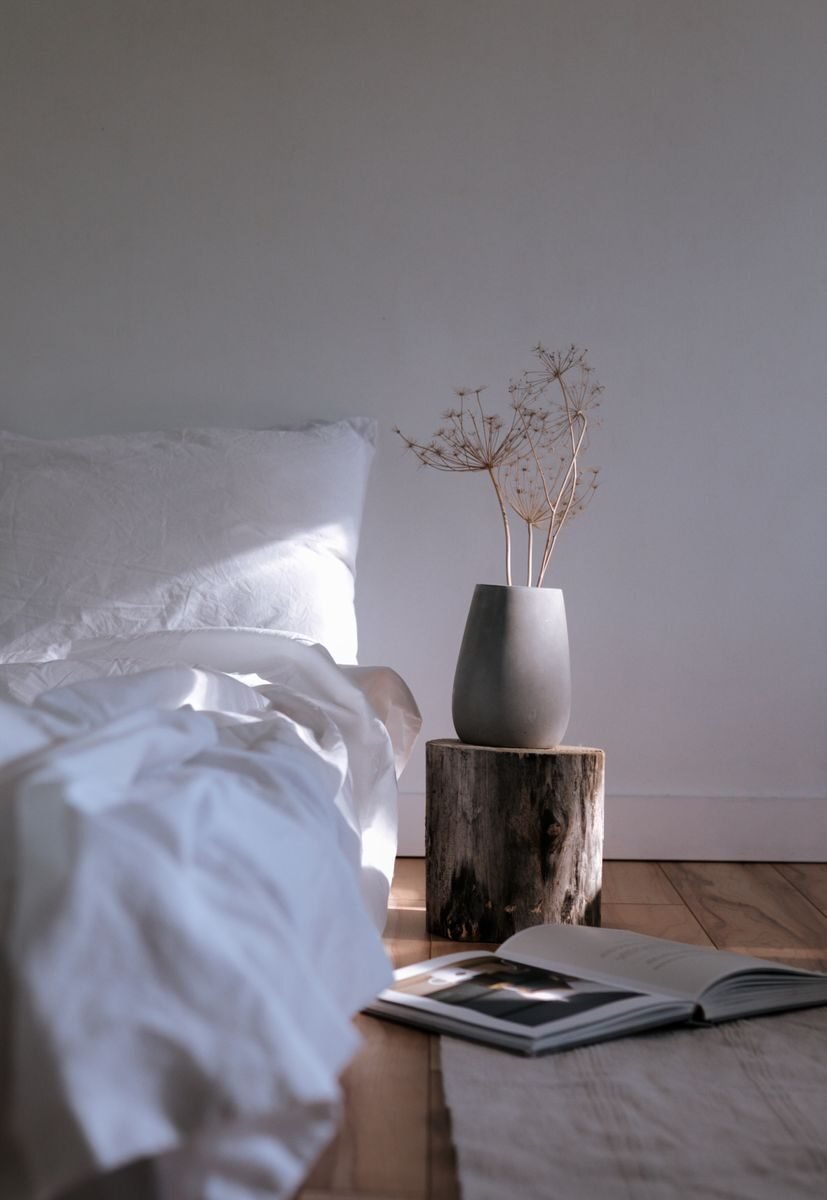
The Case for a Headboard That Reaches the Ceiling
Stand in the doorway of almost any bedroom and the thing that looks wrong is the wall behind the bed. There is a large horizontal object, a small vertical object attached to it at roughly a metre, and then a great deal of empty wall running up to the ceiling. The eye has nowhere to go.
A standard headboard sits at exactly the height that creates this problem. It is tall enough to interrupt the wall and not tall enough to organise it. The fix is not a gallery of frames above the bed. It is to make the headboard do the job the wall is failing at.
What a full-height headboard actually does
It converts the bed from a piece of furniture into a piece of architecture. Instead of an object sitting against a wall, you get a defined zone: a panel that runs floor to ceiling, or close to it, with the bed in front of it. The room reads as though someone designed it, because someone did.
The secondary effect is more useful than the visual one. A tall panel gives you somewhere to mount reading lights at the right height, which means the bedside tables no longer have to hold lamps, which means they can be smaller, which means the room has more floor. One decision unpicks three problems.
How tall is tall enough
There are three heights that work and one that does not.
- Full height, floor to ceiling. The strongest version. Best in rooms with ceilings under about three metres, where it reads as panelling rather than as a wall of headboard.
- To picture-rail height. In a period room with a rail or a cornice, stopping at that line looks deliberate and costs less material.
- Roughly two-thirds of the wall. The safe option, and the one to choose if the wall has a window or a radiator complicating it.
- Just above pillow height. This is the standard headboard, and it is the one that creates the problem in the first place.
Materials, in order of how well they age
Timber panelling
Slatted or flat, stained rather than painted. It is the most forgiving option because it can be repaired, it does not show marks, and it works in almost any style from Japandi through to farmhouse. It is also the version you can build yourself over a weekend if you are reasonably confident with a saw.
Upholstery
Softer, warmer against your back, and considerably better acoustically in a room with hard floors. The catch is cleaning: a full-height upholstered panel is a large surface at head height that will eventually need attention. Choose a removable cover or a fabric you can actually wipe.
Paint or wallpaper on the wall itself
The cheapest version and the least convincing, because without a physical edge it reads as a painted rectangle rather than as a headboard. It works if you add a slim moulding to define the edge, and not otherwise.
When not to do this
If the bed cannot sit centrally on its wall, a full-height panel will make the asymmetry louder rather than quieter. If the ceiling is very high, the panel needs to stop somewhere and that stopping point becomes a design decision in its own right. And in a rented flat where you cannot fix anything to the wall, a freestanding tall headboard needs real weight at the base or it will lean forward slowly over a year.
Common questions
Will a tall headboard make a small bedroom feel smaller?
No, and usually the opposite. The instinct is that a large object shrinks a room, but a small room feels cramped because it has too many competing elements, not because any one of them is large. Replacing four things on that wall with one thing calms it down. The same logic runs through most of our small space ideas.
How much should it cost?
A slatted timber panel across a standard double wall, built yourself, is a weekend and the price of the timber. Made to measure and upholstered, expect it to cost roughly what a good bed frame costs. It is one of the few interventions where the DIY version and the professional version look genuinely similar.
Related reading
For the rest of the room, our bedroom ideas cover lighting and storage, which are the two things a headboard cannot fix. If the low, quiet register in the photographs above is what you are after, start with Japandi. And if the room is dark as well as awkward, what to do with a bedroom in February is about exactly that problem.