Outdoor Planter Box Styling Secrets Pro Landscapers Actually Use
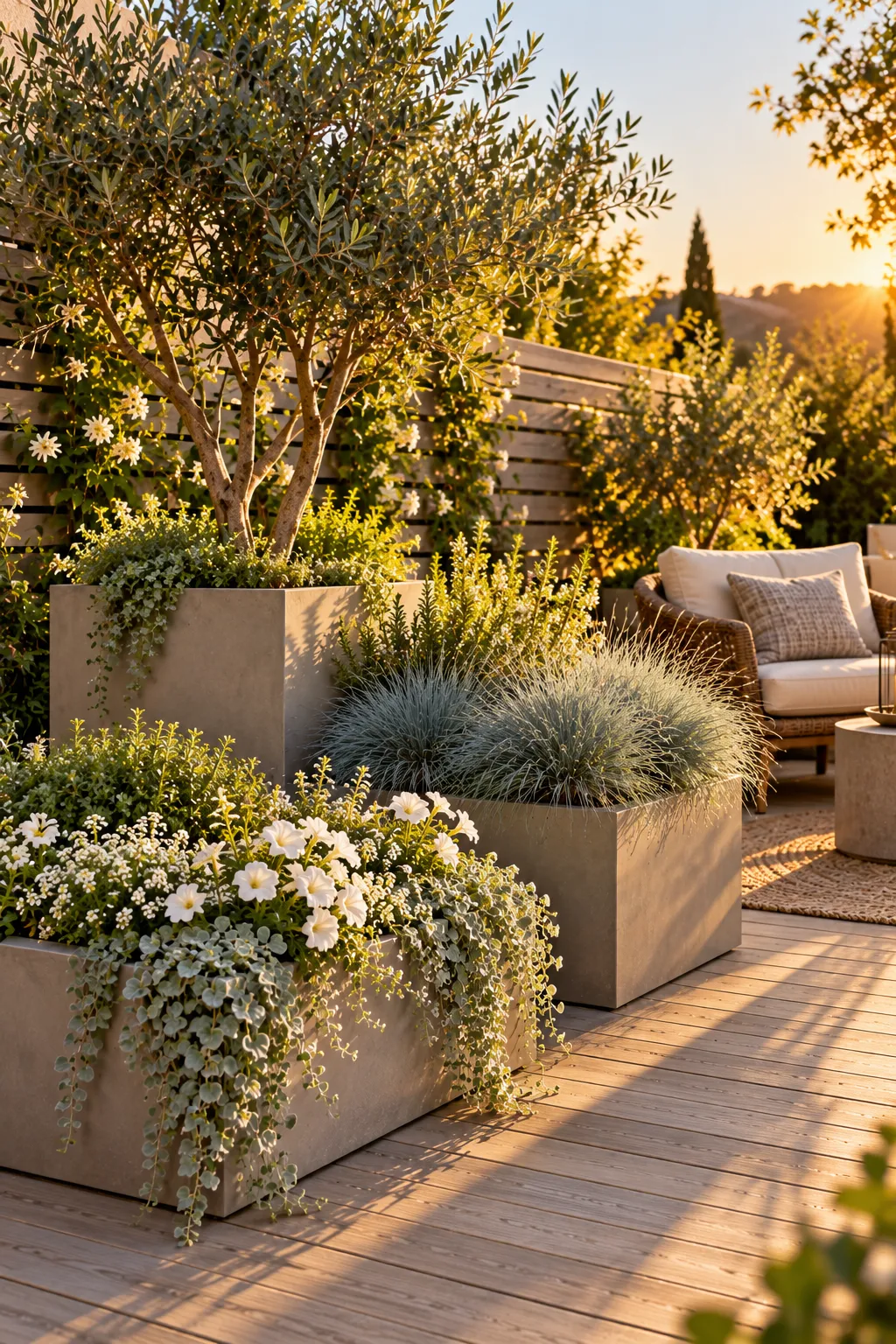

Ever notice how a landscaper’s planter looks finished the day it goes in, while a home planter can look like a random mix from the garden center? The difference is rarely the plants. It comes down to a handful of decisions about scale, material, repetition, and restraint that professionals make almost automatically.
This guide covers those decisions for outdoor planter box styling. Each idea is a different approach, from single-grass boxes that move in the breeze to winter displays that hold their shape when everything else has faded. Pick the ones that suit your space, and you’ll know which plants to buy, how to arrange them, and why the look works.
Plant One Grass in a Long Box and Let It Move
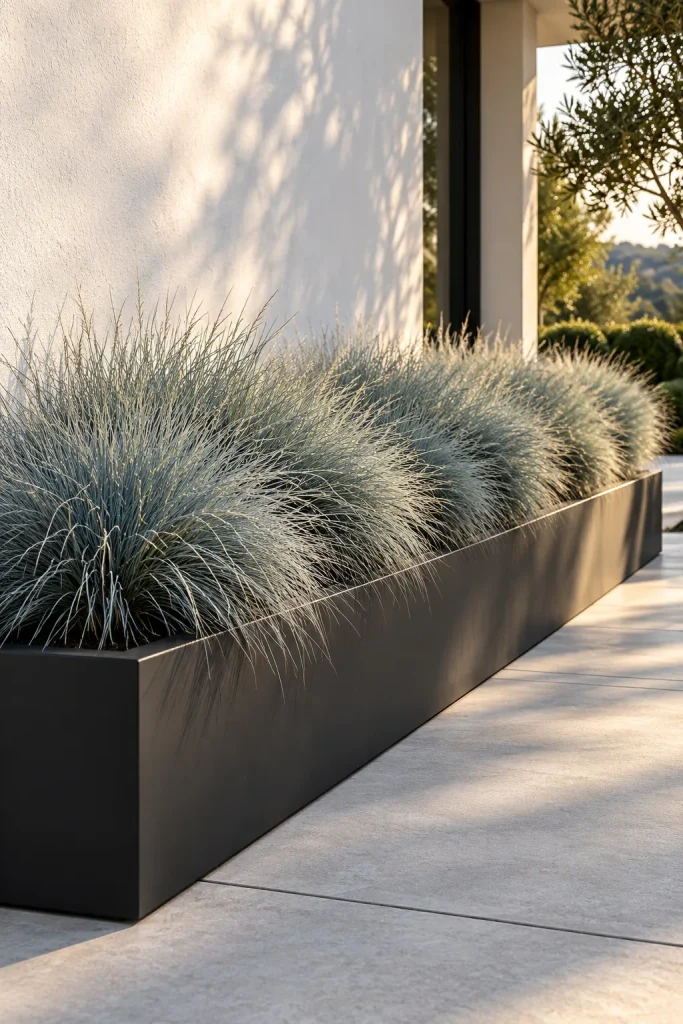
Most people put five different plants in one box, and that’s often why their planters look busy. On modern homes, landscapers often do the opposite. They choose one species, plant it densely, and repeat it from one end of the box to the other. A long rectangular planter filled only with blue fescue or a compact lomandra looks clean, architectural, and calm, and when the wind picks up, the whole row ripples together.
Plant closer than the label suggests, about 20 to 25 cm apart, so the box looks full in its first season. Smooth concrete or matte black fiberglass suits this look best. Fill the soil to about 3 cm below the rim so the grass looks like it’s rising out of the box rather than sinking into it.
Match the Planter to Your House, Not the Garden Center Display
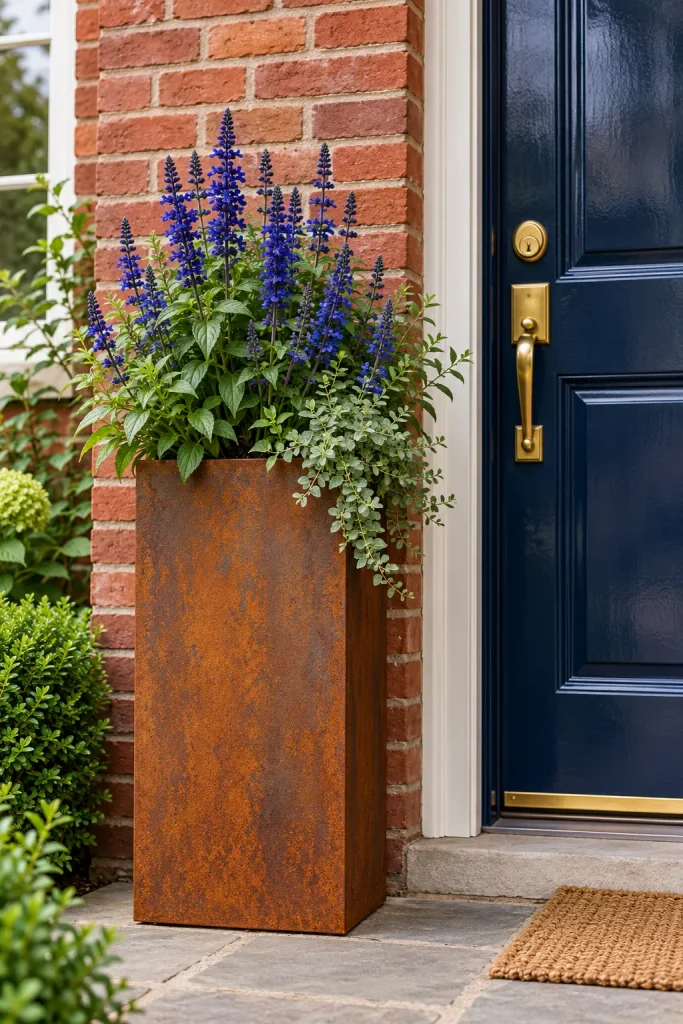
Pros choose the container before the plants, and they choose it by looking at the house. Weathered corten steel looks great against red brick because the rusty orange tones complement each other. A white rendered or stucco home looks sharp with smooth pale concrete or charcoal fiberglass. Timber cladding suits cedar or hardwood boxes with a simple oiled finish.
This step is the backbone of good outdoor planter box styling, and it’s the one most DIY setups skip. Take one more detail from the facade, such as the color of your front door or window frames, and repeat it in the flowers. For example, a navy door paired with deep blue salvia in a rust-toned box looks deliberately planned, even though it took only a moment’s thought.
Grow a Privacy Screen Instead of Building One
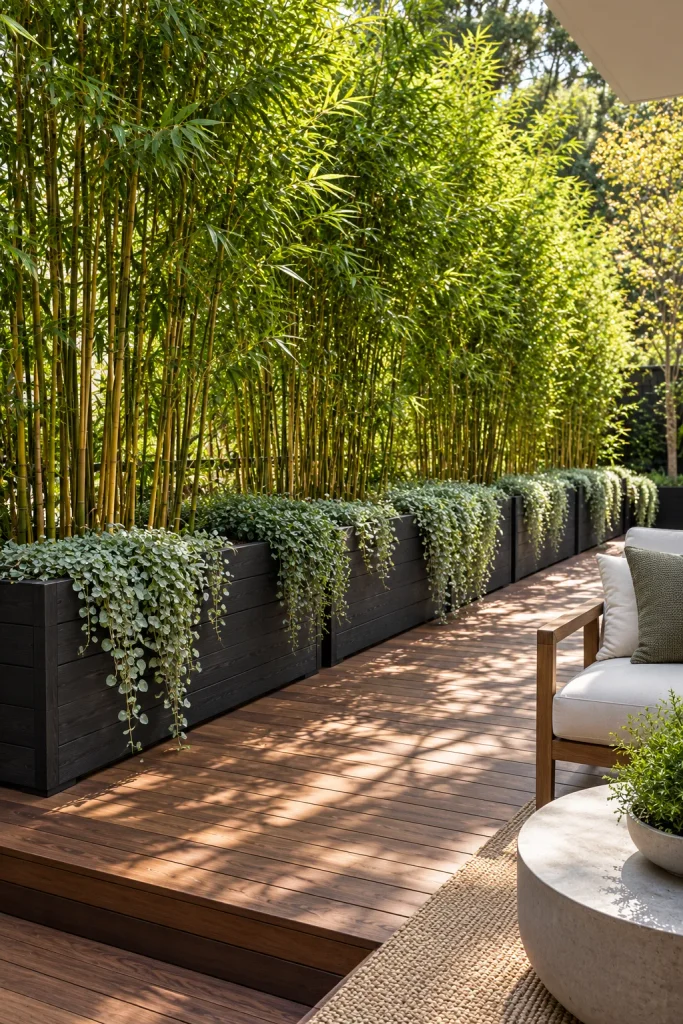
A long, deep trough planter along the edge of a deck can block a view like a fence, but it looks much softer. Choose upright plants that stay narrow, such as clumping bamboo (never a running type), tall feather reed grass, or a slim columnar shrub like a narrow pittosporum. The box should be at least 45 cm deep and wide so the roots have room and the plants don’t dry out during a hot week. If you line up several identical troughs end to end, you get one continuous green wall instead of a row of separate pots.
To finish the look, underplant the front edge with something low and soft, such as creeping thyme or dichondra. This hides the bare stems at the base, which is where most screens look unfinished. Timber boxes stained a dark charcoal fade into the background, so the plants stay the focus.
Treat Your Herbs Like Ornamentals
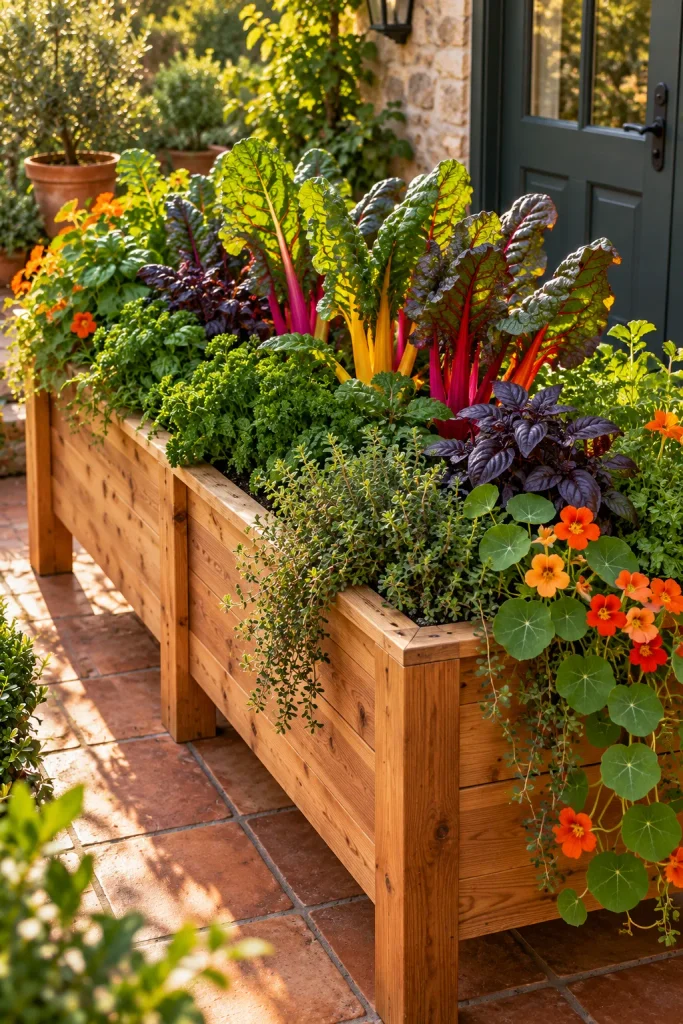
Edible planters often look messy because they’re planted like a vegetable patch, with rows, gaps, and whatever happened to be on sale. A potager-style box takes the opposite approach and arranges edibles the way a designer would arrange flowers. Put rainbow chard in the center for height and those glowing pink and yellow stems. Edge it with curly parsley, add purple basil for contrast, and let thyme and nasturtiums spill over the corners.
Place this box near the kitchen door so you’ll actually use it. Harvest from the back and sides first, which keeps the front full and photo-ready. A box about 30 cm deep handles everything here comfortably.
Break the Symmetry at Your Front Door
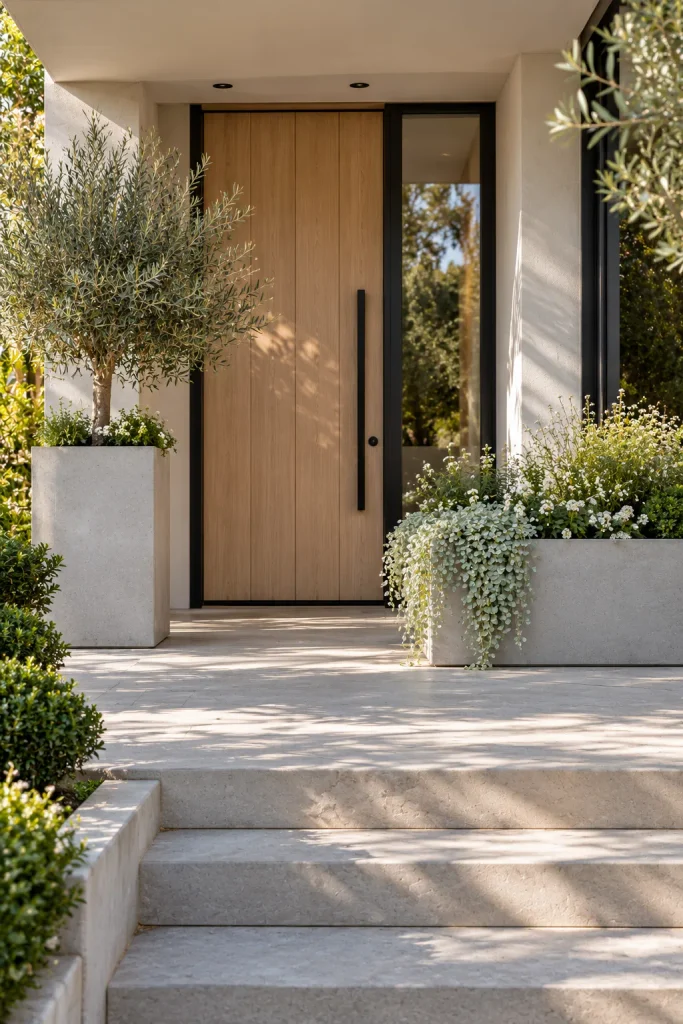
Twin boxwood balls in matching pots by the door are everywhere, and that’s exactly why they’ve become invisible. A fresher approach uses two planters in the same material but at clearly different heights. Put a tall, slim box holding a sculptural plant like a standard olive or a dark cordyline on one side, and a low, wide box with soft trailing plants on the other.
The result feels relaxed and modern, more like a designed entry than a catalog copy. To keep the two sides connected, repeat one element in both, such as the same silver foliage or the same white flower. That single link is what makes the arrangement read as one idea rather than two unrelated pots.
Plant a Moon Box for Evenings Outside
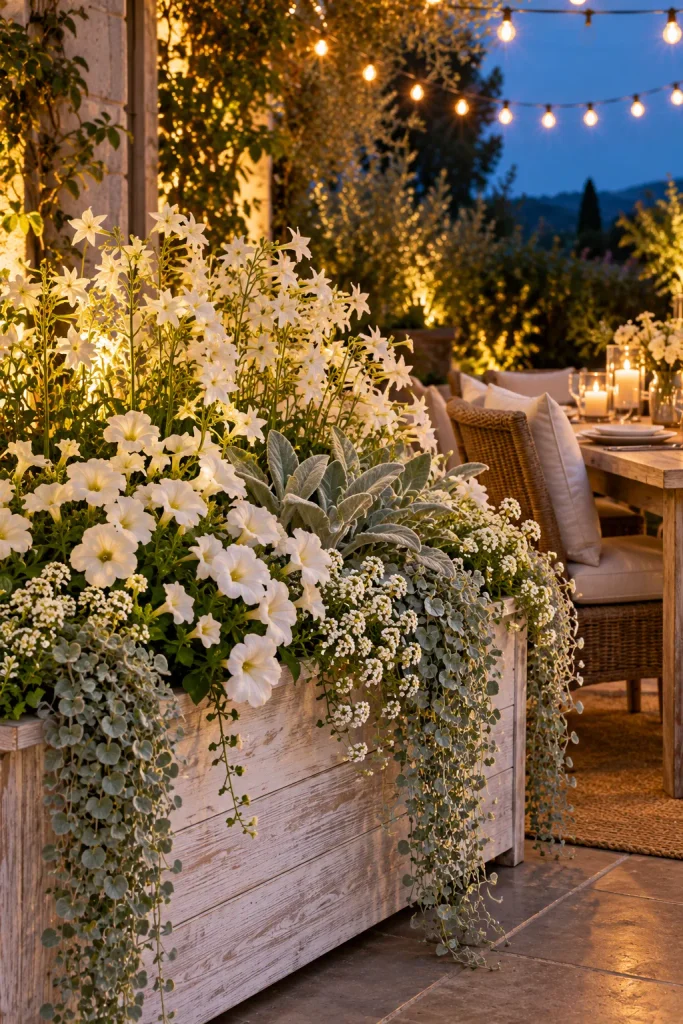
White flowers and silver leaves keep reflecting light long after colorful blooms fade into the dusk. That’s the idea behind a moon box, a planter designed to look its best in the evening. Fill it with white nicotiana, sweet alyssum, white petunias, lamb’s ear, and trailing silver dichondra. Nicotiana and alyssum also release their scent as the air cools, so place the box right next to where you sit after dinner.
Lift Your Planters Onto Legs
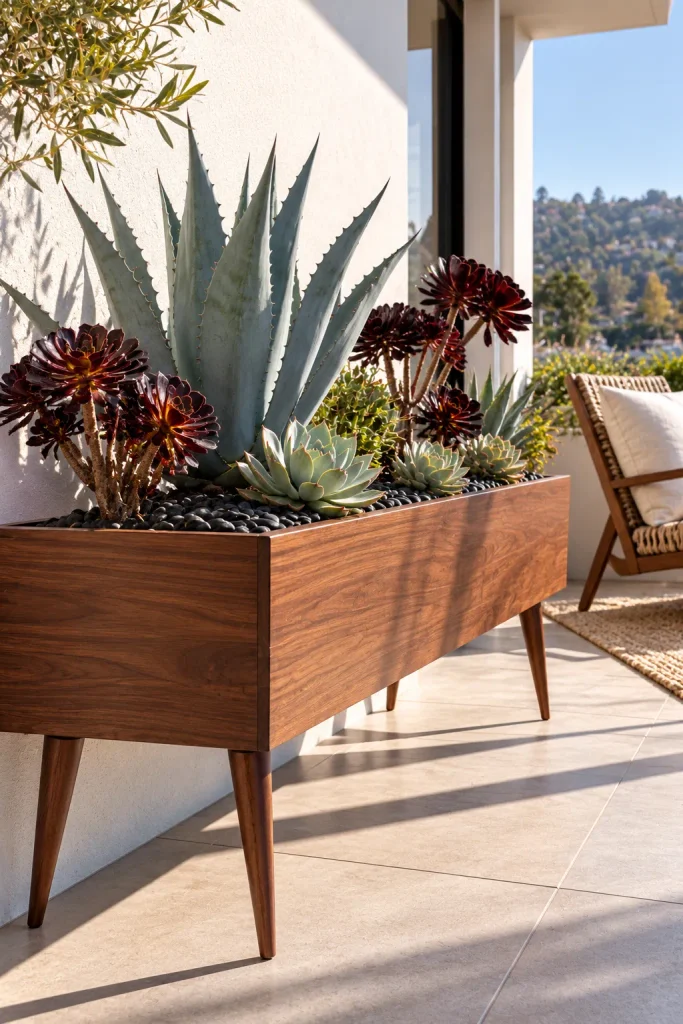
A planter raised on slim tapered legs immediately looks more like furniture, which suits balconies, verandas, and mid-century homes. Sculptural succulents work especially well at this height: a blue agave, a few dark aeoniums, and tight echeveria rosettes placed with space between them so each shape stands out.
The professional finishing touch here is top dressing. Cover any bare soil with crushed granite, black river pebbles, or fine gravel. This hides the potting mix, slows evaporation, and makes the whole planter look complete. Raising the box also improves drainage and stops water stains from forming on timber decking.
Give a Small Tree Its Own Box
One small tree in a generous square planter can anchor a whole courtyard. Japanese maples, dwarf crepe myrtles, and compact magnolias all handle container life well when the box is at least 60 cm in every direction. Underplant with shallow-rooted ground covers like mondo grass or baby’s tears so they don’t compete with the tree’s roots. Place it where the eye naturally lands, such as at the end of a path or in the corner you can see from the living room window. Up-close, the layered look of a tree rising out of a soft green carpet is what makes it feel professionally done.
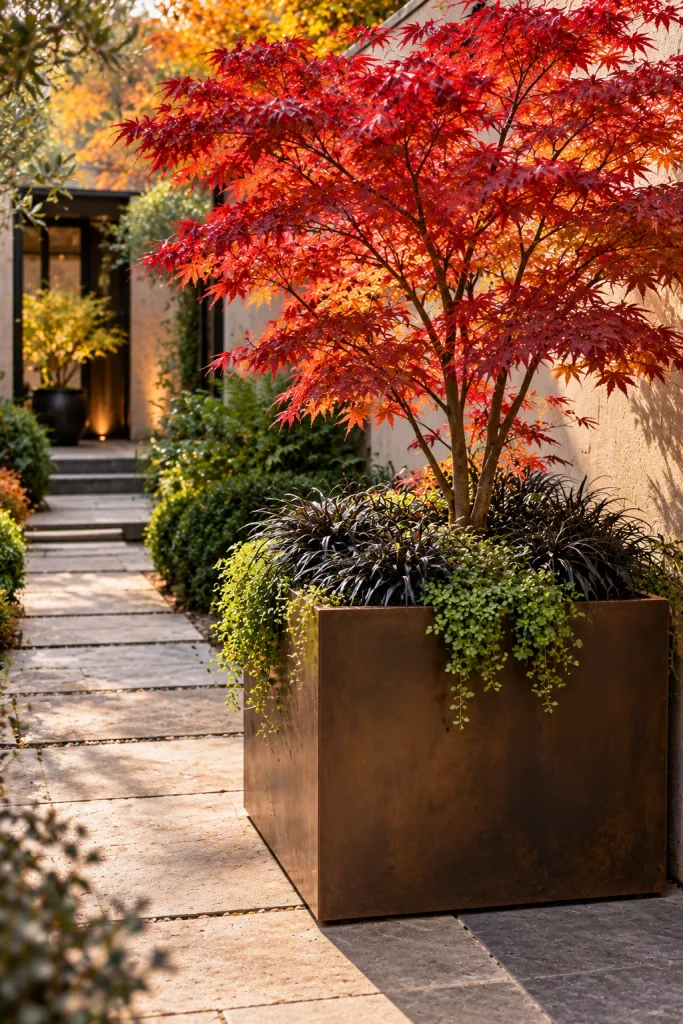
Use the Pot-in-Pot Trick in Window Boxes
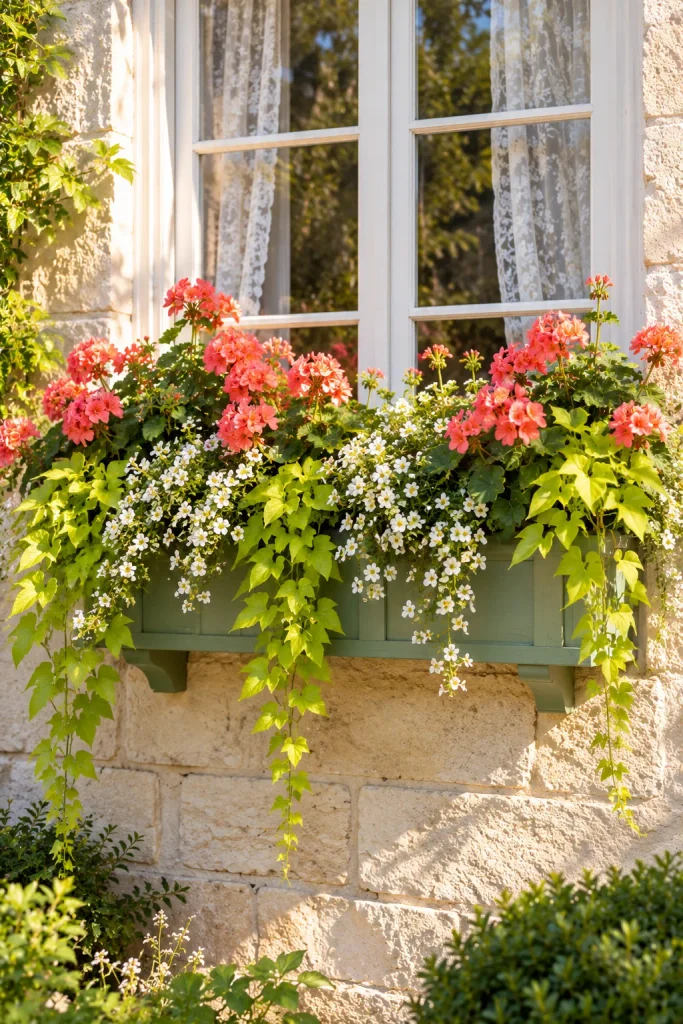
Here’s a trick commercial landscapers use all the time. Rather than planting straight into a window box, they drop in plastic liners or individual grow pots and pack the gaps with moss or mulch. When the summer display starts to look tired, they lift the pots out and slot in fresh ones, and the whole box changes in about ten minutes.
For styling, aim for roughly half upright flowers and half trailing plants, so the box spills generously below the sill. Ivy geraniums, bacopa, and lime sweet potato vine create that full European cottage look. Keep the color scheme to two main colors so it looks full rather than chaotic.
Cluster Three Boxes in One Material
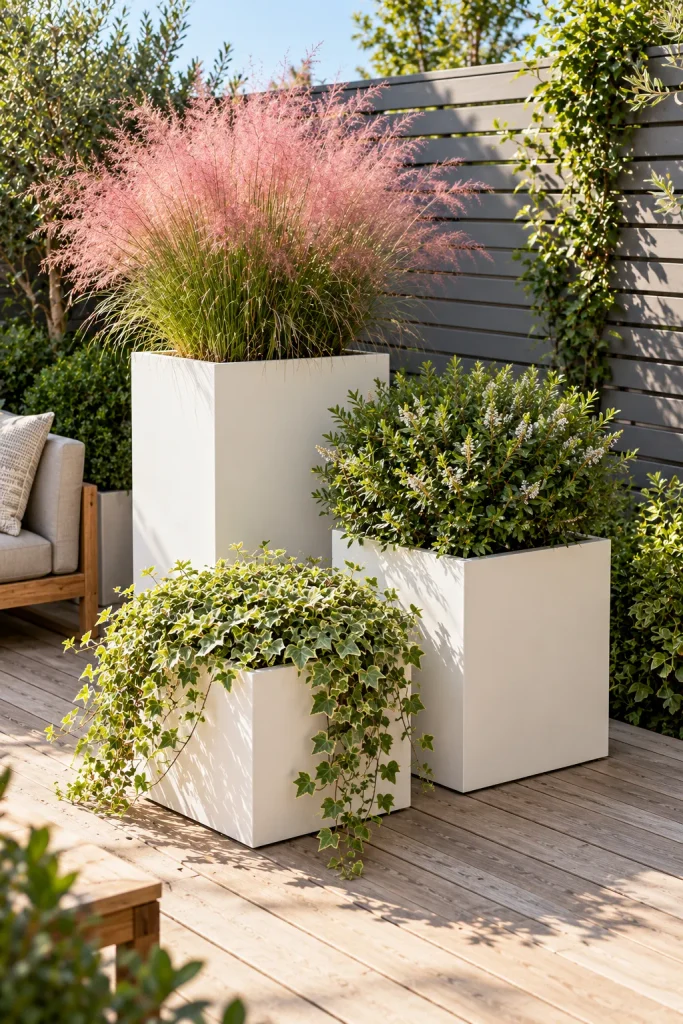
One of the easiest improvements in outdoor planter box styling is scale. Pros almost always go bigger than you’d expect, because small boxes look lost against a house wall. A group of three in different sizes, made from the same material, gives you that size and variety without one huge, expensive planter. Put the tallest at the back, stagger the other two in front, and arrange them in a loose triangle rather than a straight line.
Because the boxes match, you can vary the plants more freely: a tall grass in the back, a mounding shrub in the middle, and a trailing plant in the front. The shared material keeps the grouping looking like one designed arrangement.
Go Mediterranean With Olive and Lavender
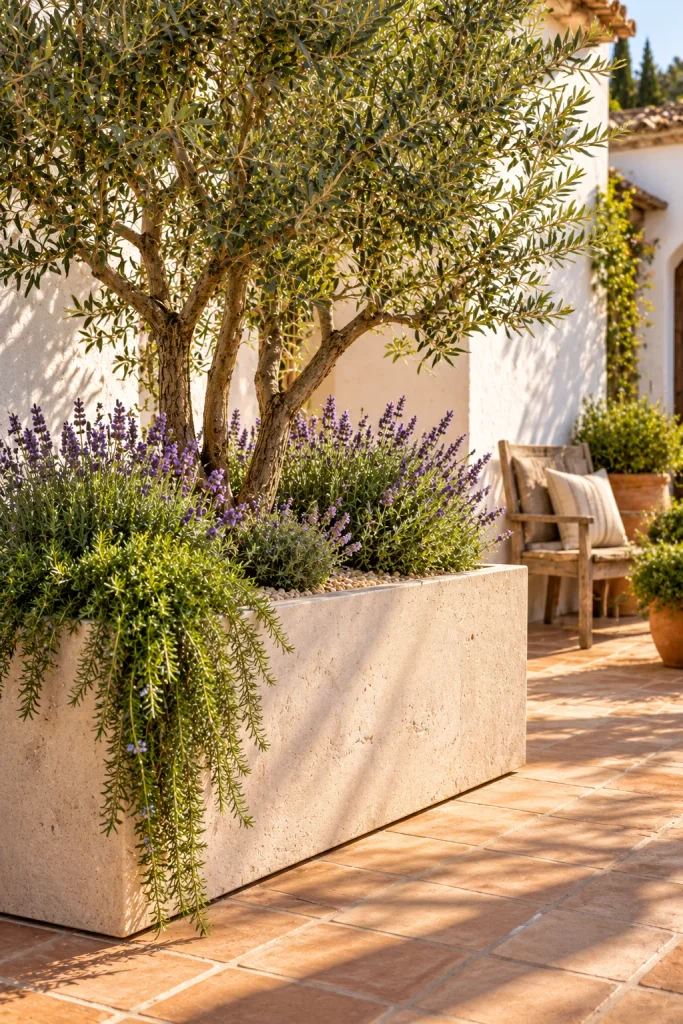
Sun-baked courtyards suit plants that actually like the heat. A pale stone-look box holding a multi-stemmed olive, a ring of lavender, and rosemary trailing over one edge looks relaxed and smells wonderful in the afternoon sun. Use a gritty, free-draining mix and top it with pale gravel, which reflects light and keeps roots from sitting wet. Once established, this combination needs far less water than a typical flowering planter.
Build Planters Into Your Seating
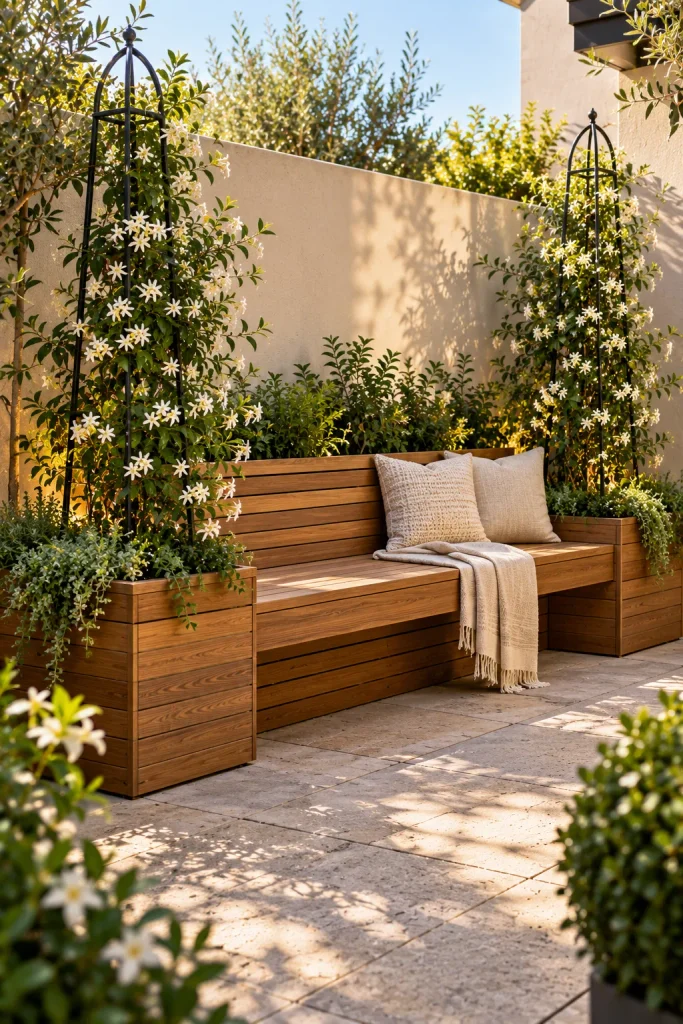
On a small patio, every square meter counts, and a bench with planter boxes built into each end saves a lot of floor space. Landscapers love this setup because the seat and the greenery are designed as one piece, so the area looks planned from day one. Horizontal timber battens wrapping both the bench and the boxes make the combination look polished.
Plant something with height and scent at either end, such as star jasmine trained up a slim steel obelisk or a clump of tall grass. This frames the seat like a pair of bookends. Add a couple of outdoor cushions and you have a reading corner that took up almost no extra room.
Light Your Planters From Within
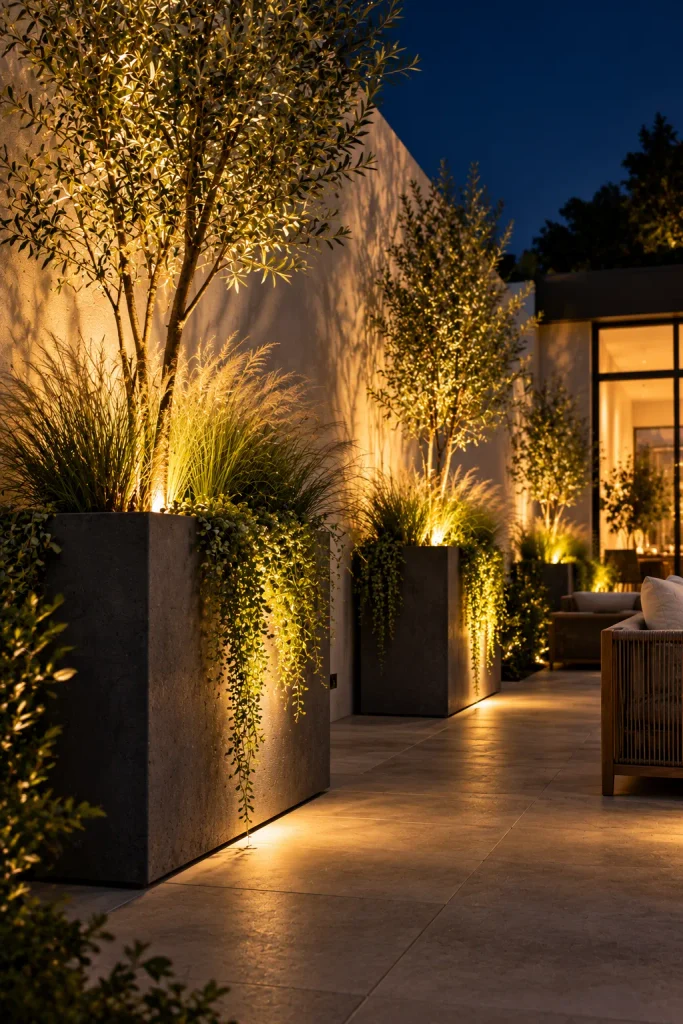
A planter that disappears at sunset is only doing half its job. Small spike uplights tucked inside the box, aimed up through grasses or into the canopy of a small tree, create soft shadows and a gentle glow after dark. Choose warm white bulbs around 2700K, since cooler light makes leaves look flat and bluish. Hide each fixture behind foliage so you see the light, not the hardware. Solar spikes work for a quick test before you commit to a low-voltage system.
Fill a Shady Corner With Foliage, Not Flowers
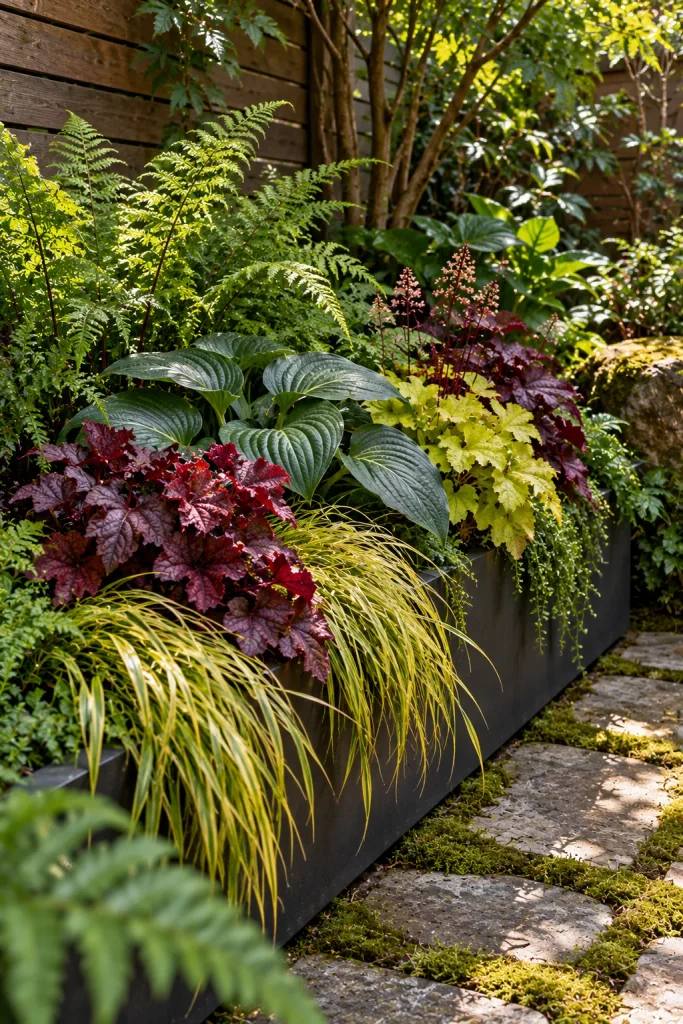
Flowering plants sulk in shade, but foliage thrives there, and pros lean on leaf color and texture to do the work. Pair lacy ferns with heuchera in burgundy or lime, add a hosta with broad ribbed leaves, and finish with golden Japanese forest grass arching over the edge. These contrasting shapes keep the box interesting all season without a single bloom.
Container color matters a lot in low light. A dark charcoal or deep green box makes lime and gold foliage stand out, while pale containers can look washed out in shade. If the corner is truly dim, add a mirror or a light-colored wall nearby to bounce more light into the space.
Dress Your Boxes for Winter
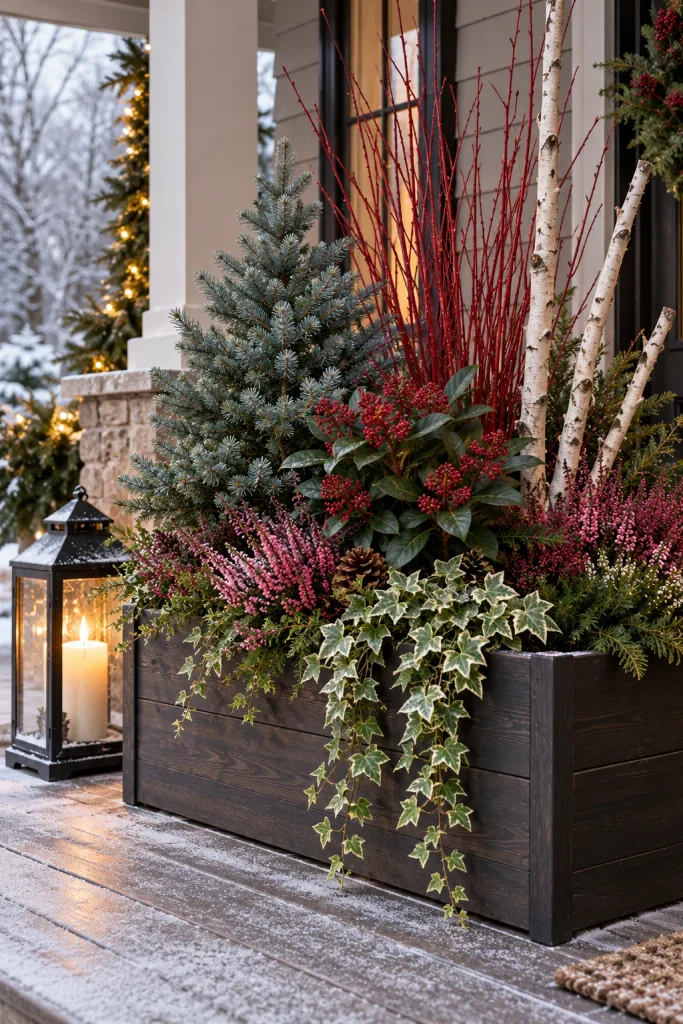
Empty boxes in winter are one of the most common gaps in outdoor planter box styling, and landscapers rarely leave them bare. The cold-season approach focuses on structure: a dwarf conifer for height, skimmia or winter heather for color, and trailing ivy around the edges. Then comes the designer touch. Push cut red-twig dogwood stems and white birch branches straight into the soil for height, and tuck a few pinecones near the base.
Because the cut stems don’t need to grow, they last for months in cool weather. Swap in spring bulbs once the season turns, and the same box keeps working all year.
You don’t need to try all of these at once. Pick the one that solves a real problem in your yard, whether that’s the shady corner, the bare front step, or the patio you avoid after dark, and start there. Once you see how much a single well-chosen planter changes the way a space feels, outdoor planter box styling becomes the easy part, and the next box usually follows soon after.