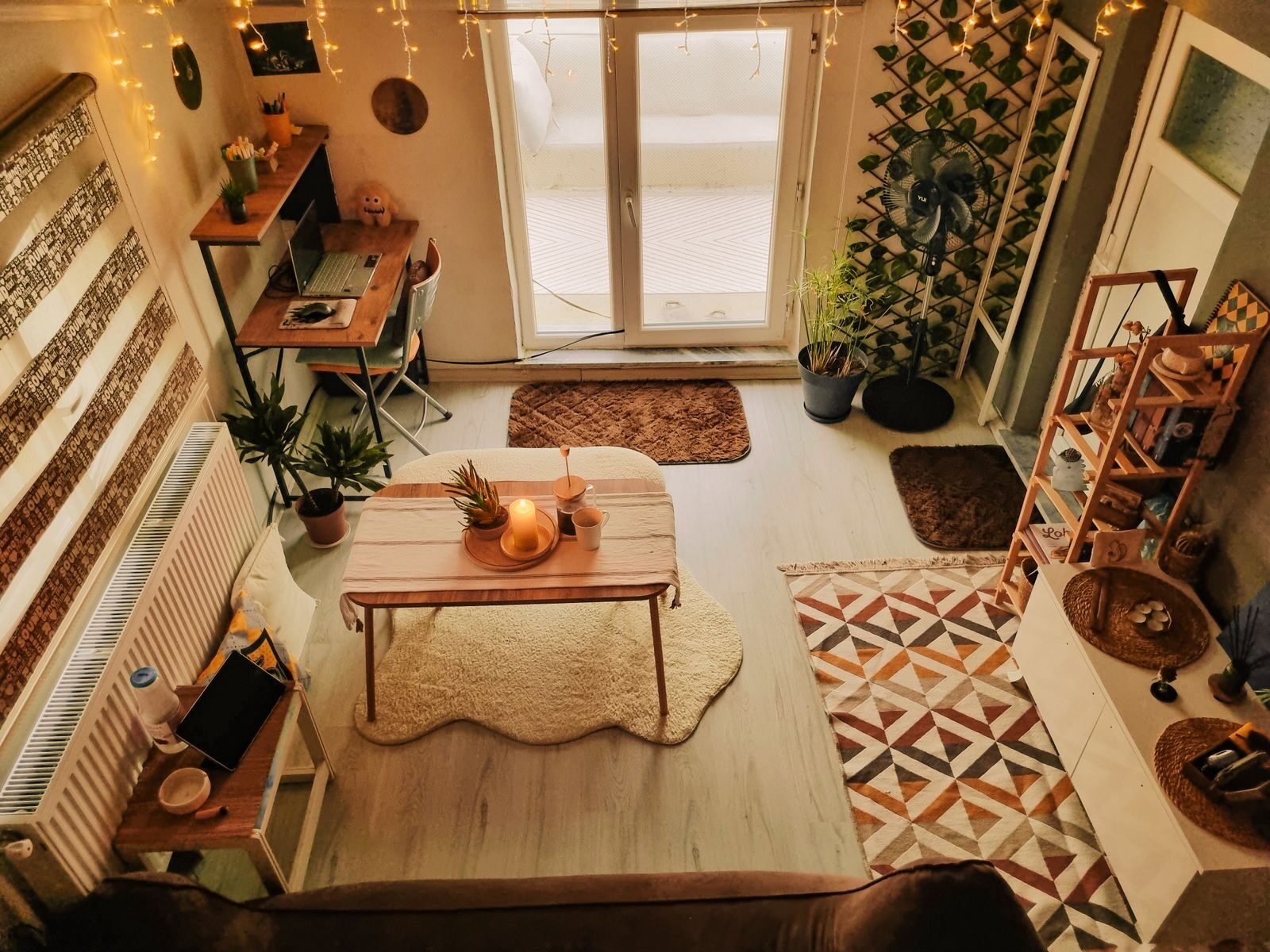
The Desk Setup That Survives Being in a Living Room
Most home offices are not rooms. They are a desk bought quickly during a difficult year, placed in the corner of a room that already had a job. They work, in the narrow sense that a laptop fits on them. They also make the entire house feel faintly like an office, which is a slower and more corrosive problem.
The fix is not better furniture. It is a boundary — something that lets the working zone visibly close at the end of the day, so the room stops broadcasting unfinished work at you while you are trying to watch television.
Choose the wall before you choose the desk
The instinct is to tuck a desk into the least useful corner. This is usually wrong, because the least useful corner is least useful for a reason: no light, no socket, and directly in a walkway. A desk there will be uncomfortable and you will stop using it.
The better position is against the wall that gets side light from a window, with the desk perpendicular to the glass rather than facing it or backing onto it. Facing a window means glare on the screen. Backing onto it means you are a silhouette on every video call. Side-on solves both, and it is the single most useful thing in this article.
The four things that make it stop looking like an office
- No visible cables. This does more than anything else. A cable tray under the desk and one plug going to the wall. If you can see three white cables, the corner reads as workstation regardless of how nice the desk is.
- A desk with legs, not a box. Seeing floor underneath keeps the corner light. A boxy pedestal desk with drawers to the ground reads as furniture from a completely different room.
- A lamp rather than a task light. A warm table lamp does the same job as a bright architect lamp, works when the desk is closed, and is not a piece of office equipment.
- A chair you would keep. A mesh office chair is the loudest possible signal. If you need the ergonomics, that is a real requirement, but consider whether a good wooden or upholstered chair plus a proper cushion gets you there for the hours you actually work.
The shut-down rule
Whatever the setup, there should be a version of it that takes ninety seconds to reach and leaves the desk surface clear. A laptop into a drawer, a monitor turned to the wall, a lid closed. The point is not tidiness. It is that the room has two states, and you get to decide which one you are in.
This is why a desk with one shallow drawer beats a desk with none, even in a minimal setup. There has to be somewhere for the working layer to go.
The video call problem
What is behind you is a design brief now, whether or not you want it to be. Three things read well on camera: a plain wall with one object on it, a bookshelf that is genuinely yours rather than styled, or a plant with real depth behind it. Three things read badly: a bed, a doorway into another room, and a window.
If the only available wall puts your bed in shot, turn the desk ninety degrees and accept a slightly worse light position. The call happens more often than you think.
Common questions
Is a fold-away desk a good idea?
In principle yes, in practice only if it folds away in under a minute and you can leave the monitor set up. Most wall-mounted fold-downs require unplugging everything, which means after two weeks it stays down permanently and you have bought a small, wobbly desk.
What about working from the dining table?
Fine for a day a week, corrosive as a permanent arrangement, because the room that is supposed to be for eating together becomes the room where work lives. If it is the only option, keep everything in one box that goes into a cupboard at the end of the day.
Related reading
More on the working end of the house in our home office ideas. If the desk is going into a genuinely small flat, small spaces and apartments covers the zoning question in more detail. And for the discipline of getting a room down to only what earns its place, minimalist is the relevant thread.