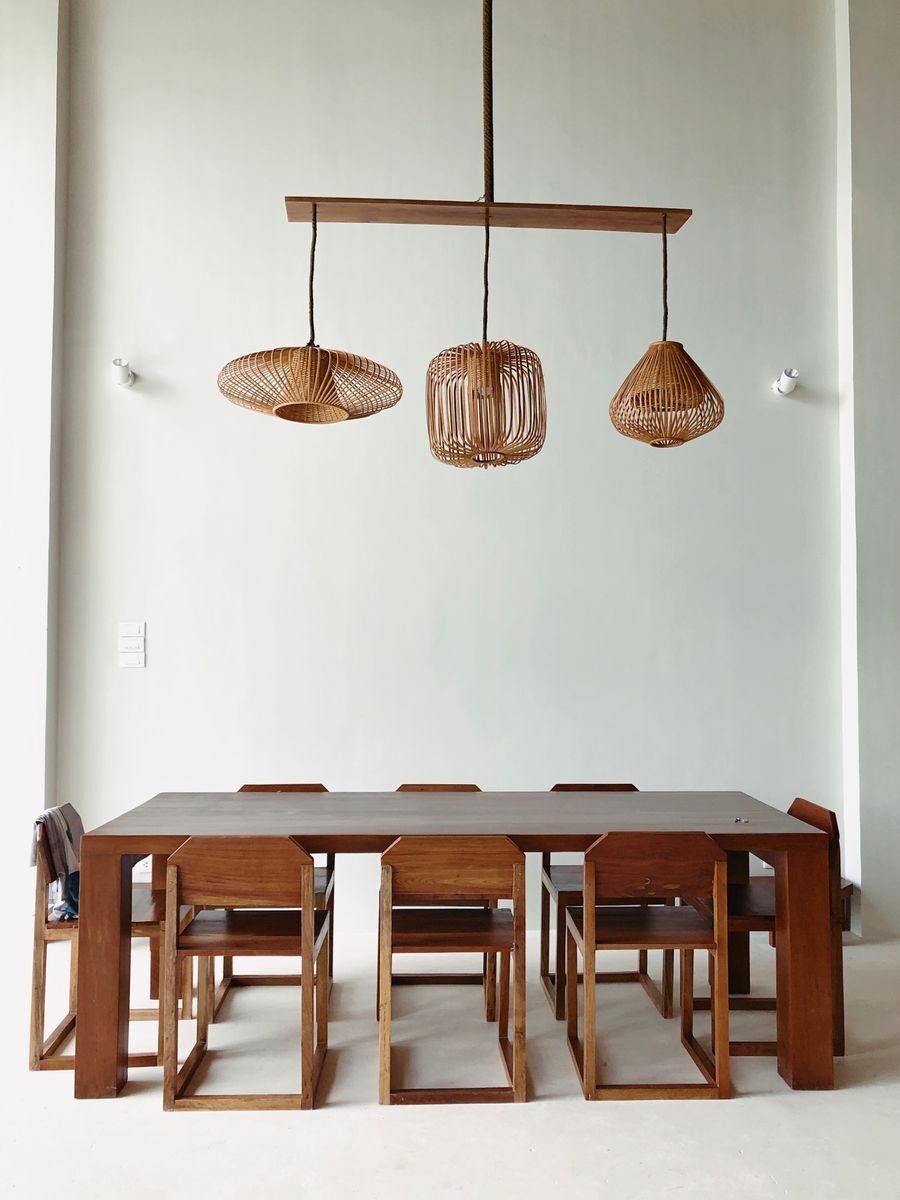
Your Dining Pendant Is Hanging Too High
There is a measurement that separates dining rooms that feel like rooms from dining rooms that feel like a table in a space, and it is the distance between the tabletop and the bottom of the pendant above it. Almost everyone gets it wrong in the same direction: too high.
The instinct is understandable. A low pendant looks like something you will walk into, and while you are standing in an empty room holding a light fitting, it is. But nobody stands in the middle of a dining table. The pendant is hung for people who are sitting down.
The number
Between 75 and 90 centimetres from the tabletop to the bottom of the shade. In a room with a standard ceiling, that puts the fitting lower than feels right and exactly where it should be. Go to the upper end if the shade is large or the ceiling is high, the lower end if the shade is small or the room is intimate.
Two adjustments. If anyone at the table will be looking across at someone opposite, check the sightline while seated — you want the shade above eye level or clearly below it, not exactly at it. And if the shade is open at the bottom with a visible bulb, hang it slightly higher, or use a frosted lamp, because a bare filament at head height is unpleasant for the two people either side of it.
Why hanging low actually makes the room better
A pendant hung at the correct height does something a ceiling light cannot: it creates a pool of light with a defined edge, and everything outside that edge falls away. The table becomes the brightest thing in the room and the walls recede. That is why restaurants do it, and it is the single cheapest way to make an ordinary dining room feel like somewhere you would linger.
Hang the same fitting thirty centimetres higher and the pool widens, the edges soften, and you get general illumination — which is what a ceiling light already does, less attractively.
Sizing the fitting to the table
- One pendant: the shade should be roughly one third of the width of the table. On a 90 cm wide table, that is a 30 cm shade. Smaller than that and it disappears.
- Two or three pendants: for tables over about 180 cm. Space them evenly along the table length, with the outer two roughly a third of the way in from each end, not at the very ends.
- Linear fittings: should be between half and two thirds of the table length. Any longer and the room starts to feel like a boardroom.
- Round table: one central pendant, always. Two over a round table never resolves.
The part people forget: a dimmer
A dining pendant at full brightness during dinner is a mistake regardless of height. Fit a dimmer, and if the fitting takes an LED lamp, buy one that dims warm rather than staying at the same colour temperature as it goes down. The difference between a room at four in the afternoon and the same room at nine in the evening should be visible.
If the table is not centred under the ceiling rose
This is extremely common in period houses, where the rose is centred on the room and the table is not. There are three honest fixes: move the table, move the electrical point, or hang the pendant from the existing point and swag the cable across to a ceiling hook above the table. The third is the cheapest and looks deliberate if the swag is generous and the cable is a good one. A short apologetic swag looks like a mistake.
Common questions
What if we have low ceilings?
Reduce the shade size before you reduce the drop. A smaller fitting at 75 cm above the table works in a low room. A large fitting pulled up to clear the ceiling gives you neither the pool of light nor the proportion.
Do we still need a ceiling light as well?
Ideally not in the dining zone itself, though a wall light or a lamp elsewhere in the room helps stop the lit table floating in a black surround. That secondary light is what keeps a low pendant feeling atmospheric rather than theatrical.
Related reading
The rest of our dining room ideas deal with the other half of the problem, which is clearance and chair depth. Light fittings are one of the places where mid-century design still has the best answers. And the same principle — light low, in pools, rather than high and even — is what drives our approach to garden lighting.